DealDash has turned pay-per-bid auctions into a business doing well over $50 million a year — and it did it with a surprisingly simple mechanic: sell bids, reset a timer, and let the excitement do the marketing. If you’ve ever looked at sites like DealDash and wondered what it takes to run one yourself, the honest answer is: less than you think on the technology side, and more than you think on the business side.
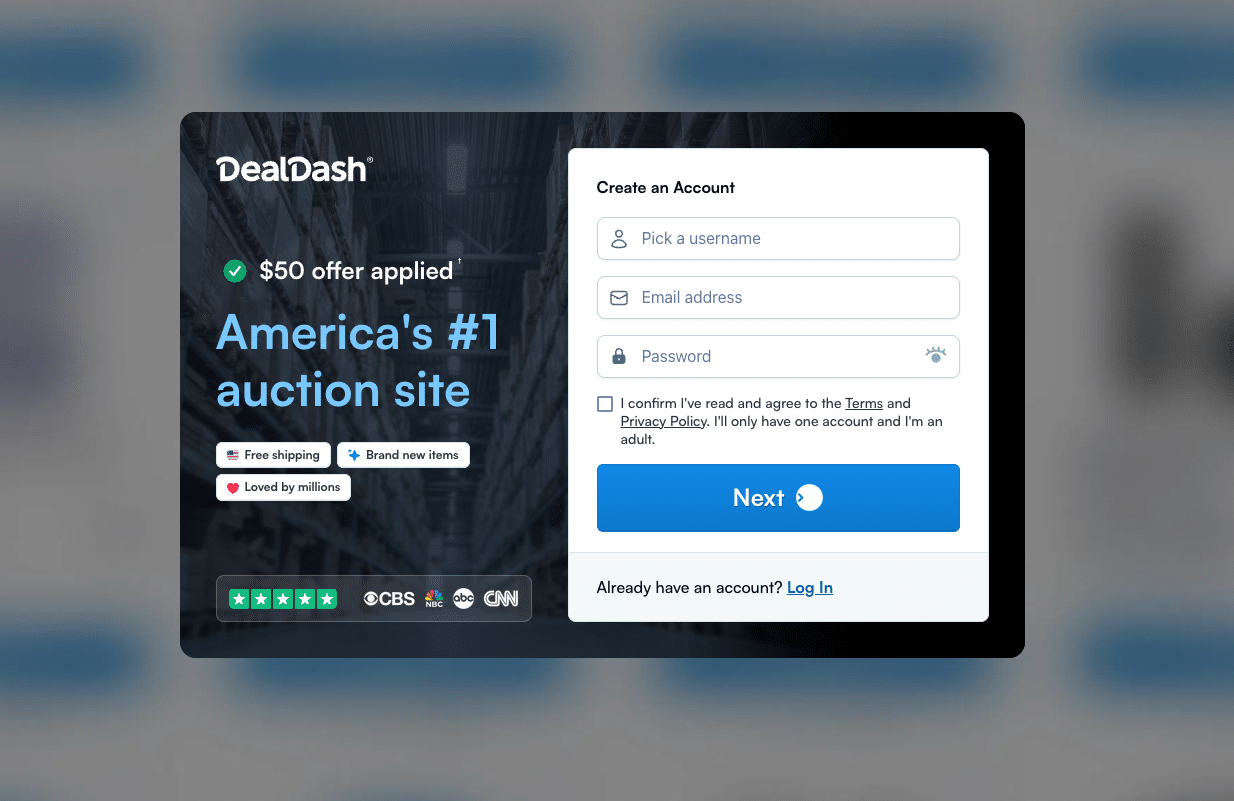
In this guide we’ll walk through the whole process of starting a penny auction website — how the business model actually makes money, what the legal landmines are, what features your platform absolutely needs, and the three ways to build it (only one of which makes sense for most first-time founders).
What Is a Penny Auction, Exactly?
A penny auction (also called a bidding-fee auction) works differently from eBay-style auctions in one crucial way: bidders pay for every bid they place, whether they win or not.
Here’s the typical flow:
- An item — say an iPad with a $500 retail value — starts at $0.00.
- Users buy “bid packs” in advance (for example, 100 bids for $60, so $0.60 per bid).
- Each bid raises the item price by one cent and resets a countdown timer (usually 10–30 seconds).
- When the timer hits zero with no new bids, the last bidder wins the item at the final displayed price.
So an iPad might “sell” for $42.50 — a headline-grabbing 91% discount. But 4,250 bids were placed to get there, and at $0.60 per bid, the site collected around $2,550 in bid revenue plus the $42.50 final price. That’s the entire magic of the model: the discount the winner sees and the revenue the site earns are two completely different numbers.
This is why penny auctions are one of the few auction formats where the platform, not the seller, captures most of the value — and why DealDash clones keep appearing year after year.
How Penny Auction Sites Make Money
Before you build anything, understand your revenue streams, because they dictate which features you’ll need:
Bid pack sales. This is 80–90% of revenue on most penny auction sites. Users pre-purchase bids in bundles, and every bid spent is revenue for you regardless of the auction outcome.
Final auction price. The winner also pays the closing price of the item. It’s small per auction, but it adds up.
Buy It Now (BIN). This is the feature that made DealDash’s model sustainable. Losing bidders can buy the item at retail price and get their spent bids back (or credited). It converts frustrated losers into full-price customers and dramatically softens the “I lost money” feeling that killed many early penny auction sites.
Memberships and promotions. Some sites add VIP tiers, starter packs for new users, or paid features like extra autobidder slots.
If you take one thing from this section: build your site around bid packs + Buy It Now from day one. Sites that launched with bid fees alone earned a predatory reputation, attracted chargebacks, and burned out their user base within months.
Step 1: Pick a Niche and Study the Competition
DealDash competes broadly on consumer goods — electronics, gift cards, home items. As a new entrant you probably shouldn’t fight that battle head-on. The better play is a niche where you can source inventory cheaply and market to a defined audience:
- Gift cards only (easy sourcing, universally understood value)
- Gaming gear and collectibles
- Tools and outdoor equipment
- Local or regional auctions with fast shipping as the differentiator
Whatever the niche, the items must have a widely known retail value. The entire psychology of a penny auction depends on the user instantly seeing “this is a $999 item at $23.40.” Obscure products with fuzzy market values don’t create that tension and won’t attract bids.
Spend time on existing penny auction sites as a real user. Buy a bid pack, lose some auctions, use a Buy It Now. You’ll learn more in a $30 experiment than in a week of reading.
Step 2: Get the Legal Side Right
This is the part most “how to build an auction site” guides gloss over, and it’s the part that actually kills penny auction businesses.
Gambling classification. Because users pay money for a chance at an outcome, penny auctions sit uncomfortably close to gambling in some jurisdictions. Several U.S. states have taken action against penny auction operators, and other countries regulate bidding-fee auctions explicitly. The Buy It Now feature is also your legal friend here — when every participant can always convert their spend into product at retail value, the “pure chance loss” argument weakens considerably. Talk to a lawyer familiar with e-commerce and gaming law in your target market before launch, not after your first complaint.
Transparency requirements. Your terms of service need to clearly state the cost per bid, how the timer works, odds-related disclaimers, and refund policy. The FTC has gone after penny auction sites for deceptive advertising, almost always for hiding the true cost of participation.
Payment processing (the hidden hurdle). Most mainstream payment processors classify penny auctions as high-risk due to chargeback rates and the gambling adjacency. Stripe and PayPal may shut you down without warning once they realize what the business is. Plan for a high-risk merchant account from a specialist provider from day one — the fees are higher (often 3.5–5% plus reserves), but an account that stays open beats a cheap one that gets frozen with your revenue inside it.
Step 3: Choose How to Build It
You have three realistic paths, and they differ by roughly two orders of magnitude in cost.
Option 1: Custom development. Hire an agency to build the platform from scratch. Full flexibility, full ownership — and a realistic budget of $20,000–$80,000+ before you’ve sold a single bid, plus ongoing developer costs for every change. This makes sense only if you already have traction or funding and need something no existing platform does.
Option 2: SaaS auction platforms. Monthly-fee hosted solutions get you live fast, but you’re renting: transaction fees, limited customization, no ownership of the code, and if the provider changes pricing or shuts down, your business goes with it.
Option 3: Self-hosted auction software (the sweet spot for most founders). Dedicated online auction software built on WordPress gives you the countdown timers, bid packs, autobidder, and payment integration out of the box, running on your own hosting for a one-time cost that’s a small fraction of custom development. You own the platform, you can modify anything (it’s WordPress — the largest developer ecosystem on earth), and you can be live in days rather than months.
For a first penny auction site, option 3 is almost always the right call: your risk in this business is market risk, not technology risk, so it makes no sense to spend $50,000 validating whether people in your niche will buy bid packs.
Step 4: The Features Your Platform Must Have
Whichever route you take, measure it against this checklist. These aren’t nice-to-haves — each one exists because a penny auction without it leaks money or trust:
Real-time countdown timer with bid reset. The core mechanic. It must update live for all viewers without page refreshes, and it must be server-authoritative so users can’t manipulate it client-side.
Bid packages and credit system. Users buy bids in advance; the system deducts credits per bid and displays remaining balance prominently. Multiple pack sizes with volume discounts increase average order value.
Autobidder (bid butler). Lets users set a maximum number of bids to place automatically. This keeps auctions active around the clock and dramatically increases total bids per auction — it’s a revenue feature disguised as a convenience feature.
Buy It Now with bid recovery. As covered above, this is both your retention mechanism and part of your legal defense.
Live activity feed. Showing usernames bidding in real time creates the competitive urgency the whole model runs on.
Retail price display on every auction. The perceived-savings gap is your marketing engine; make it impossible to miss.
Anti-fraud and admin controls. One account per user enforcement, bid history logs, IP monitoring, and a full admin dashboard for managing auctions, users, and payouts. Penny auctions attract accusations of shill bidding — your credibility depends on being able to demonstrate clean operations.
Mobile-responsive design. The majority of impulse bidding happens on phones. A timer-based product that’s clumsy on mobile is dead on arrival.
Step 5: Sort Out Inventory and Fulfillment
You’ll need a steady stream of products with recognizable value. Common approaches:
- Gift cards — near-zero fulfillment complexity, digital delivery possible, value is unambiguous.
- Liquidation and wholesale lots — cheap sourcing for electronics and home goods, but check condition guarantees.
- Dropship-style retail purchasing — buy the item at retail after the auction closes. Simple, but your margin depends entirely on bid revenue exceeding retail cost, so model it carefully.
Ship fast and communicate obsessively. In a business model this scrutinized, one viral “I won and never got my item” post costs more than a warehouse of iPads.
Step 6: Launch, Seed Activity, and Market
An empty penny auction site is a ghost town nobody bids on, and an auction with no bidders never ends. Your launch plan should include:
Free bids for new registrations. The standard onboarding hook — give 10–50 free bids so users experience the mechanic risk-free.
Start with a few auctions, not fifty. Concentrated activity on 3–5 simultaneous auctions looks alive; the same users spread across 50 auctions looks dead.
Content marketing and SEO. Comparison and informational content around penny auctions is how sites in this niche pick up compounding organic traffic — reviews, “how it works” explainers, and niche product content all feed the funnel. (You’re reading an example of the strategy right now.)
Paid acquisition with caution. Google Ads has restrictive policies around penny auctions in some regions, so read the fine print before building your growth model around it. Social ads showcasing real winner results tend to perform well.
Email from day one. Auction-ending alerts, “you were outbid” notifications, and bid pack promotions drive the repeat engagement the model depends on.
How Much Does It Cost to Start?
A realistic starter budget using self-hosted auction software looks like this:
- Software (WordPress penny auction platform): one-time cost in the hundreds, not tens of thousands
- Hosting suitable for real-time bidding: $30–$100/month
- Legal review and terms of service: $1,000–$3,000
- High-risk merchant account setup: varies; budget for higher per-transaction fees
- Initial inventory float: $2,000–$5,000
- Launch marketing: $1,000–$5,000
That puts a lean but professional launch in the $5,000–$15,000 range — versus $50,000+ for the custom-development route the agencies writing most guides on this topic would prefer to sell you.
Mistakes That Kill Penny Auction Sites
- No Buy It Now. Users who feel purely fleeced don’t come back, and they do leave reviews.
- Launching without payment processing sorted. Getting frozen by a mainstream processor mid-growth is the most common sudden-death scenario.
- Too many auctions too early. Thin activity makes the site look fake.
- Ignoring the legal review. Penny auctions attract regulator attention; sloppy terms make you an easy target.
- Overbuilding. Spending a custom-development budget before validating your niche inverts the risk/reward of the whole venture.
Frequently Asked Questions
Are penny auction websites legal? In most jurisdictions yes, when operated transparently — but some U.S. states and countries regulate or restrict bidding-fee auctions. Features like Buy It Now and clear cost disclosures materially improve your legal position. Get jurisdiction-specific legal advice before launch.
How much does it cost to build a website like DealDash? From roughly $5,000 all-in using self-hosted WordPress auction software, to $50,000–$100,000+ for fully custom development. The mechanics of the auction are identical either way.
How do sites like DealDash make money if items sell for a few dollars? Through bid fees. Every one-cent price increase represents a paid bid (typically $0.13–$0.60 each), so a $40 closing price can represent thousands of dollars in collected bid revenue.
Can I run a penny auction site on WordPress? Yes — dedicated auction themes and plugins provide the countdown/reset timers, bid credits, autobidder, and payment gateways required. It’s the fastest and cheapest way to launch a functional penny auction platform.
How long does it take to launch? With ready-made auction software: days to a couple of weeks, most of which is spent on payments, legal, and inventory rather than the website itself.
Ready to Build Yours?
The penny auction model is one of the rare online businesses where the technology is a solved problem and the opportunity lives entirely in niche selection, trust, and marketing. If you want to see exactly what a ready-made platform includes — timers, bid packs, autobidder, payments and all — take a look at our online auction software and you can have a DealDash-style site running on your own domain this week.