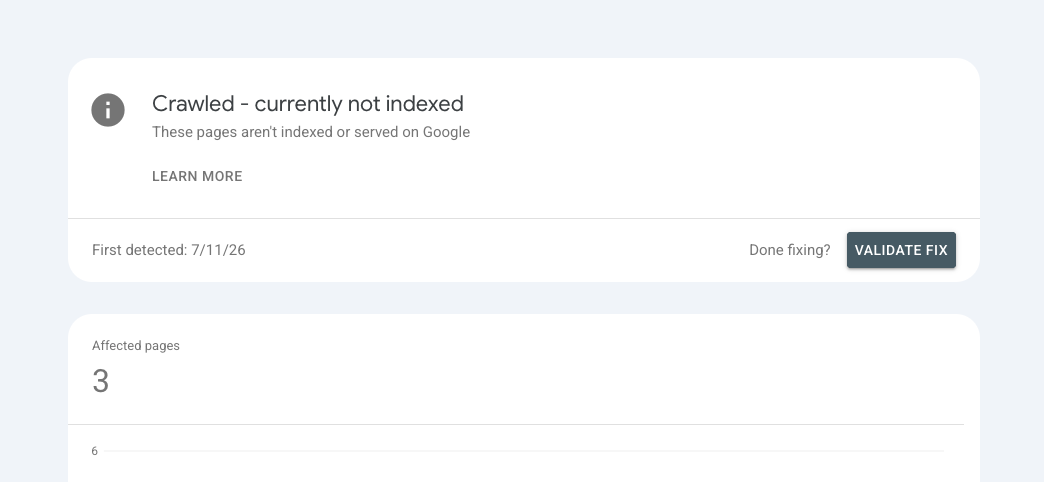
If you regularly monitor your website in Google Search Console, you may have noticed the status “Crawled – currently not indexed.” For many website owners, this warning can be frustrating, especially when new pages fail to appear in Google search results. Understanding what this message means is the first step toward fixing the problem and improving your website’s visibility.
Simply put, “crawled but not indexed” means that Google has already visited your page and analyzed its content, but it has decided not to include it in its search index—at least for the time being.
Google’s search process happens in three stages:
- Discovery: Google finds your page through links, sitemaps, or internal navigation.
- Crawling: Googlebot visits the page and reads its content.
- Indexing: Google decides whether the page deserves to be stored in its search database.
When a page is crawled but not indexed, the issue occurs during the final stage.

Why Does Google Crawl Pages Without Indexing Them?
Many website owners assume that once Google visits a page, indexing is guaranteed. Unfortunately, that is not the case. Google indexes pages only when it believes they provide sufficient value to users.
One of the most common reasons behind this issue is a lack of website authority.
Low Domain Authority and Trust
Google tends to trust established websites that consistently publish high-quality content and earn backlinks from reputable sources. New websites or websites with very few links often struggle to get all their pages indexed.
If your domain has little authority, Google may crawl dozens of pages but only index a small percentage of them. This is especially common for:
- New websites.
- Small business websites.
- Affiliate sites.
- E-commerce stores with thousands of product pages.
- Blogs with little backlink activity.
Google allocates a limited crawl budget to less authoritative websites. If your site has weak authority signals, search engines may postpone indexing some pages indefinitely.
Building authority through quality backlinks, digital PR, and strong content marketing campaigns can significantly improve indexing rates.
If you need help improving your site’s authority and rankings, you can explore our SEO services here: SEO packages.
Thin or Duplicate Content
Another major reason pages remain unindexed is content quality.
Google does not want to fill its search results with pages that offer little value. Pages with only a few sentences, duplicated product descriptions, or content copied from other websites are often crawled but excluded from the index.
Examples include:
- Category pages with no unique text.
- Product pages using manufacturer descriptions.
- AI-generated articles with little editing.
- Near-identical location pages.
- Empty blog posts.
To improve your chances of indexing, ensure that every page provides original, detailed, and genuinely useful information.
Poor Internal Linking
Google relies heavily on internal links to understand the importance of pages within your website.
Pages buried deep in your navigation structure may be crawled occasionally but considered low priority. Strengthening your internal linking strategy can signal to Google that a page deserves attention.
Consider:
- Linking from your homepage.
- Adding contextual links from relevant articles.
- Creating topic clusters.
- Using breadcrumbs.
- Updating older content with links to newer pages.
Strong internal links distribute authority across your site and help search engines understand your content hierarchy.
Technical and Quality Signals
Technical issues can also contribute to indexing problems. Although Google successfully crawled the page, certain signals may discourage indexing, such as:
- Slow page speed.
- Excessive JavaScript rendering.
- Soft 404 errors.
- Poor mobile usability.
- Temporary server issues.
- Incorrect canonical tags.
Running regular technical audits can uncover hidden problems affecting indexation.
How to Fix “Crawled – Currently Not Indexed”
There is no instant fix, but the following steps usually help:
- Improve the quality and depth of your content.
- Earn backlinks from trusted websites.
- Strengthen internal linking.
- Remove duplicate pages.
- Optimize technical SEO.
- Submit updated XML sitemaps.
- Request indexing through Google Search Console.
Most importantly, focus on increasing your website’s authority. In many cases, pages remain unindexed not because Google cannot access them, but because Google is still determining whether the site has earned enough trust.
Final Thoughts
“Crawled – currently not indexed” is not necessarily a penalty or a sign that something is broken. It simply means that Google has seen your page and has chosen not to add it to its search index yet.
For websites with limited authority, this issue is extremely common. The solution is rarely a single technical adjustment—it usually requires stronger content, better backlinks, and an overall improvement in site quality. As your website gains authority and trust, Google becomes far more likely to index new pages quickly and consistently.