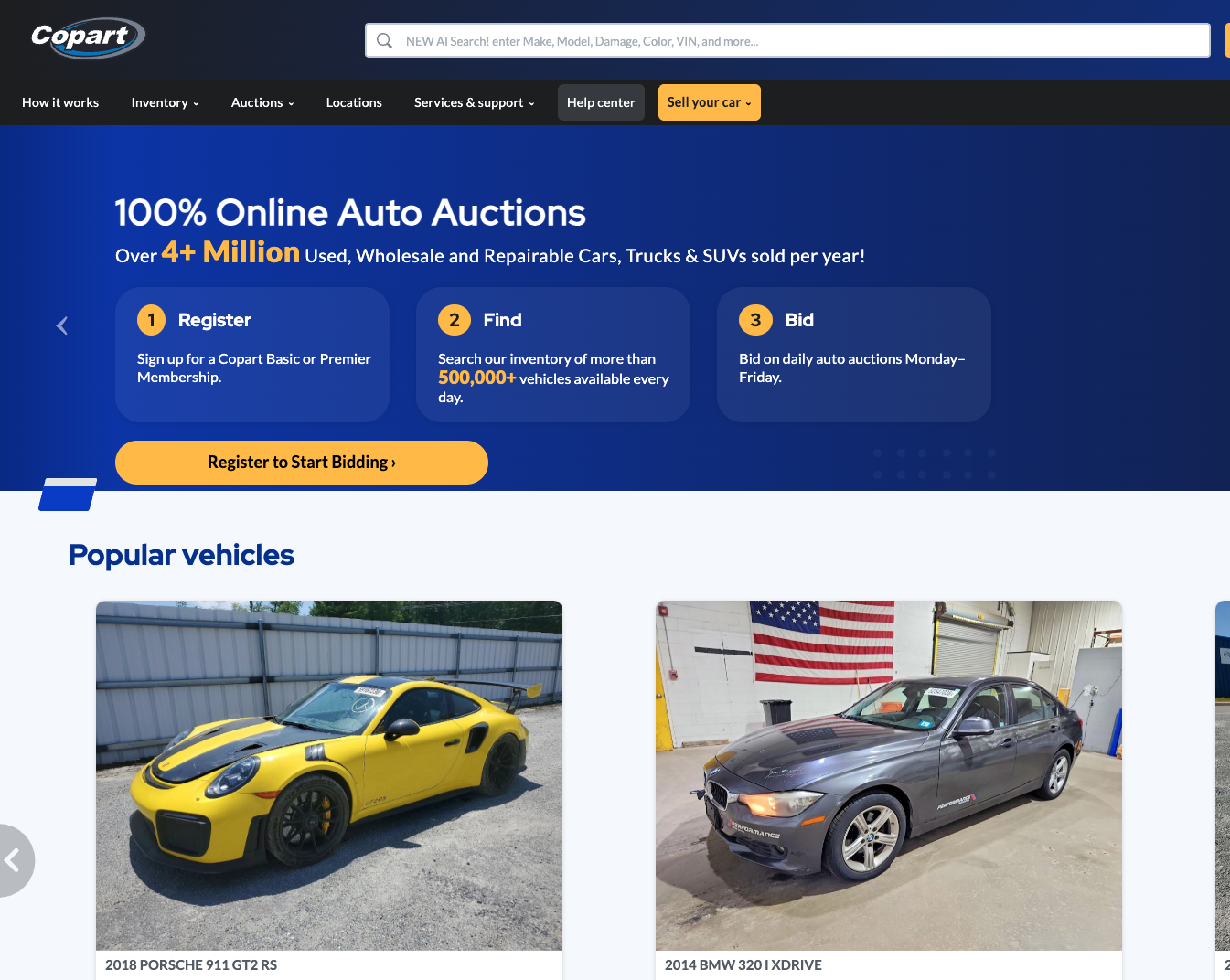
Copart lists somewhere north of 175,000 vehicles on any given day, and for most people looking for an alternative, the problem isn’t the inventory. It’s the front door.
In the majority of US states you can register, then browse and even fall in love with a lot. And then find out at checkout that a salvage-titled Civic is “dealer only” in your state.
The other complaint is fees: a $3,500 winning bid turns into roughly $4,100 once the buyer fee, the $99 internet bid fee and the gate fee land, before you’ve paid anyone to tow it.
So the useful question isn’t “what other websites exist,” it’s “which of them will let me bid, and what will it cost me to do so.” That’s how this whole list is organised. Every platform below is tagged with its access rule, and the first section is the one most people searching for this actually need.
Also as a side note, if you are looking for car auction software, we are a company that has built many auction websites, and car auction websites in the past, so you can count on us.
The short answer
If you have a dealer license, your real alternatives are IAAI, Manheim, ADESA and ACV. If you don’t, you have two routes: a Copart broker (AutoBidMaster, A Better Bid, SalvageReseller, RideSafely, AuctionExport) that bids on Copart for you, or a platform that’s open to the public in its own right (SCA Auction, eBay Motors, GovDeals).
And if what you actually want is a cheap, driveable car rather than a rebuild project, skip salvage entirely and go to government surplus auctions.
Copart’s biggest competitor, if you want a single name, is IAAI. It’s the only other company processing insurance total-losses at anything like the same scale.
Every option at a glance
| Platform | What it is | Who can bid | Best for |
|---|---|---|---|
| IAAI | Direct competitor, insurance salvage | Dealers; public in some states | Same hunt, different inventory |
| SCA Auction | Independent salvage auction | Public | Rebuilders, parts cars |
| AutoBidMaster | Copart broker | Public | International buyers, first timers |
| A Better Bid | Copart broker | Public | US buyers who want simple onboarding |
| SalvageReseller | Copart broker | Public | Budget-conscious US buyers |
| RideSafely | Broker for Copart and IAAI | Public | Bidding on both in one account |
| AuctionExport | Broker + exporter | Public, mostly non-US | Shipping a car overseas |
| Bid.cars | Copart/IAAI aggregator and history tool | Public | Research before you bid |
| eBay Motors | Public marketplace | Public | Clean-title used cars, no broker |
| GovDeals / GSA Auctions | Government surplus | Public | Cheap fleet and police vehicles |
| Manheim | Wholesale auction | Dealers only | Lease returns, trade-ins |
| ADESA | Wholesale auction | Dealers only | Retail-ready stock |
| ACV Auctions | Digital wholesale | Dealers only | Inspection-heavy buying |
Direct competitors: salvage auctions that run their own yards
1. IAAI (Insurance Auto Auctions)
IAAI is the platform Copart watches. It runs the same business, insurance write-offs, flood recoveries, theft recoveries, plus a slice of clean-title fleet and dealer stock, and it does it at roughly 2.5 million vehicles a year against Copart’s 4 million. The two inventories overlap on type but not on actual cars: State Farm might contract with one, Progressive with the other, so if you’re chasing a specific model in a specific colour you search both.
Fees are close enough that it’s not worth picking on price. Where IAAI is different: condition reports are a bit more thorough, the Buy Now feature covers more lots, and the site is less crowded with international bidders pushing prices up on clean Toyotas. Where it’s worse: fewer yards in some regions, and the bidding interface feels older.
Public access works the same way as Copart, decided state by state. IAAI publishes its own eligibility table, and in about a dozen states you can buy a good share of the inventory without a license. Elsewhere you need a broker. RideSafely (below) covers IAAI; most Copart brokers don’t.
Access: Dealer license, or public in select states, or broker.
2. SCA Auction
SCA is the one genuinely open salvage auction with real scale. It’s owned by the same group behind AutoBidMaster and A Better Bid but runs its own physical locations and its own inventory rather than reselling Copart lots. Anyone can register and bid, in any state.
The catch is what’s on offer. SCA leans heavily damaged: rolled trucks, burned interiors, parts-only lots. If you’re a dismantler or a rebuilder who can price a frame pull in your head, that’s fine. If you’re a first-time buyer hoping to find a lightly-dented Corolla, you’ll spend a lot of time scrolling. Their blog also aggressively markets SCA as “the Copart alternative,” so read the listings, not the marketing.
Access: Public, no license.
Brokers: how the public gets into Copart without a license
A broker is a licensed dealer who holds a Copart (or IAAI) account and bids on your behalf. You see the same lots, place the bid on the broker’s site, and if you win the broker buys the car, invoices you, and handles the title. You pay Copart’s fees plus the broker’s own fee, typically $200 to $400 per vehicle depending on price and membership tier. That sounds like a lot until you compare it with getting a dealer license, which in most states means a business location, a surety bond, insurance and several months.
Which broker is best mostly comes down to where you live and whether you need shipping.
3. AutoBidMaster
The biggest and the one I’d point international buyers to. AutoBidMaster gives public buyers the full Copart catalogue, with no license and free basic registration, and it has spent years building out the parts of the process that trip people up: shipping quotes to a container port, export paperwork, history reports bundled into the listing.
The interface is more forgiving than Copart’s own. Fees are middle of the pack, and their upgraded membership tiers make sense only if you’re buying several cars a year.
Access: Public. Broker fee on top of Copart fees.
4. A Better Bid
Same parent company as AutoBidMaster, aimed more squarely at US buyers who want the simplest possible onboarding. Registration takes minutes, there’s a fee calculator on every lot so you can see the all-in cost before bidding, and support will help schedule pickup and title release. International shipping support exists but is thinner. If you’re in Ohio buying a car in Ohio, this is probably the least painful route.
Access: Public. Broker fee applies.
5. SalvageReseller
A Florida-based Copart broker that’s been around since the mid-2000s and competes mostly on price. Broker fees are generally lower than the two above, and there’s no membership fee to get started. The trade-off is a plainer site and less hand-holding. Experienced buyers who already know how Copart works and just need a licensed seat tend to like it for that reason.
Access: Public. Broker fee applies.
6. RideSafely
RideSafely’s pitch is one account that bids on both Copart and IAAI, and for a lot of buyers that’s the whole reason to use it. If you’re searching for a 2019 F-150 with front-end damage and there are four on Copart and three on IAAI, you can watch all seven from one dashboard with one fee schedule. Deposit requirements are a bit higher than pure Copart brokers, and the site is less polished, but the dual coverage is hard to get elsewhere.
Access: Public. Broker fee applies.
7. AuctionExport
Built for people who are not in the US and want a car shipped to them. AuctionExport bids on Copart, IAAI and Manheim, then takes over the part most brokers hand off: inland transport, container loading, and the export documentation for the destination country. Popular with buyers in Nigeria, Ukraine, the UAE and the Caribbean. It is not the cheapest broker, and you’re paying for coordination, so if you already have a freight forwarder you trust, AutoBidMaster plus your own forwarder will usually come out ahead.
Access: Public, aimed at non-US buyers.
8. Bid.cars
Not strictly an auction, but worth having open in a second tab. Bid.cars aggregates current Copart and IAAI listings and, more usefully, keeps a searchable archive of past sales by VIN, with photos. Before you bid on anything, search the VIN here. You’ll sometimes find the same car sold through Copart 18 months ago with a different damage description, which tells you a lot about what you’re buying. They also offer broker bidding, but the archive is the main event.
Access: Public (research free, bidding via broker).
Wholesale auctions: dealer-only, and different cars entirely
These come up in every “Copart competitors” list, and technically they are competitors, since Copart also sells clean-title fleet and dealer stock. But their core business is off-lease and trade-in vehicles, not damage. If you’re a public buyer you can skip this section.
9. Manheim
The largest wholesale operation in North America, owned by Cox Automotive, moving millions of lease returns, rental de-fleets and dealer trade-ins a year. Condition reports are detailed, arbitration exists if a car isn’t as described, and there’s a real used-car market here rather than a salvage lottery. Dealers only, strictly enforced, and the fee structure assumes you’re buying in volume.
Access: Licensed dealers.
10. ADESA
Manheim’s traditional rival, now owned by Carvana, which bought it in 2022 mainly for the physical sites. Similar inventory, similar rules. Some dealers find pricing a touch softer than Manheim at certain locations because the buyer pool is smaller, but that varies week to week.
Access: Licensed dealers.
11. ACV Auctions
Digital-first wholesale. ACV’s whole model is that its own inspectors photograph, scan and write up every vehicle before it’s listed, including engine audio recordings and undercarriage imaging, so you’re buying a known quantity rather than guessing from six photos. Prices reflect that. It’s the right platform if your time is worth more than the discount you’d get from gambling.
Access: Licensed dealers.
Public marketplaces: no license, no broker, no salvage
12. eBay Motors
Underrated as a Copart alternative because people forget it exists. eBay Motors has plenty of salvage and rebuilt-title cars listed by dealers and by the rebuilders who bought them at Copart, plus a huge clean-title private market.
No membership, no deposit, no eligibility table. Prices are higher than auction because the seller’s already added their margin, but you can message the seller, ask for a video, and in many cases go and see the car. For a first purchase, that’s worth a lot.
Access: Public.
13. GovDeals and GSA Auctions
If you’ve been searching for Copart alternatives because you want a cheap car rather than a project, this is the section to read twice. Government fleet vehicles (police interceptors, municipal pickups, agency sedans) go through GovDeals at the state and local level and GSA Auctions at the federal level. They sell clean-title, usually with a full maintenance history, and often with the kind of low-highway-mileage that fleet use produces. Registration is free and open to anyone.
The downside is cosmetic: decal shadows, drilled dashboards, bench seats in the Crown Vics. And you’re competing against taxi operators and rural dealers who know exactly what these cars are worth. Still, a 2018 Explorer Interceptor at $6,000 with a documented service record is a better bet than a $4,000 Copart Explorer with “front end” as the entire damage description.
Access: Public.
Outside the US
The Copart brand exists in the UK, Canada, Germany, Spain, Finland, Ireland and elsewhere, but each runs on local rules and inventory, so “Copart UK” is effectively a different auction. British buyers should also look at Synetiq (owned by IAA’s parent) and e2e Total Loss; Canadian buyers have Impact Auto Auctions; Australians have Pickles and Manheim Australia. Public access is generally easier outside the US, since the dealer-license system is largely an American thing.
Can you skip all of this and just buy on Copart?
Sometimes, yes, and it’s cheaper if you can. Copart has a “No License Required” filter that shows only vehicles you’re eligible to buy in your state.
The list of what’s open to the public changes with state law, but as a rough guide: clean-title vehicles are buyable by the public almost everywhere, salvage-titled vehicles are dealer-only in most states, and a handful of states (Texas, Ohio, Florida, Georgia among them, though check Copart’s state licensing page before relying on this) let the public buy most salvage lots directly.
To bid you need a membership. Pricing moves around, but as of 2026 Basic runs around $59 to $99 a year with a low bid cap, and Premier around $249 to $259 a year with a refundable deposit that sets your bidding limit at ten times the deposit. If you’re buying one car and it’s eligible in your state, a Basic membership plus the standard fees beats any broker. If it isn’t eligible, no membership tier changes that, and you’re back to the broker list.
What the winning bid doesn’t include
The number you bid is maybe 80% of what you’ll pay, and less on cheap cars. Before you place a bid on any of these platforms, have a figure in your head for all of the following:
- Buyer fee (tiered by sale price; $500 or more on anything over $8,000 at Copart)
- Internet bid fee, $99 at Copart for online bids
- Gate fee and any document or title handling fee
- Broker fee, if you’re using one
- Storage after the free window, usually $25 to $50 a day
- Transport, which can exceed the car’s price on a cheap lot shipped cross-country
- Sales tax at registration
- Repairs, and the fact that a rebuilt title knocks 20 to 40% off resale and makes some insurers walk away
Run the VIN yourself, on Bid.cars and on a paid history report, rather than trusting the listing. Damage descriptions on salvage auctions are written by the yard, in a hurry, from the outside of the car. “Minor dents” has covered a lot of sins.
Building your own vehicle auction site
The interesting thing about this whole list is how much of it is middlemen. Half the platforms above don’t own a single car; they charge a few hundred dollars for a licensed seat and a nicer interface. Copart proved salvage auctions scale, and the brokers proved there’s money in just providing access to them.
If you’re thinking about launching a vehicle auction marketplace of your own, whether that’s a local salvage auction, a broker front-end, or a specialised niche like fleet or classic cars, our WordPress car auction theme handles bidding, reserves, proxy bids and listings out of the box, and our team builds custom auction platforms end to end. Get a quote.