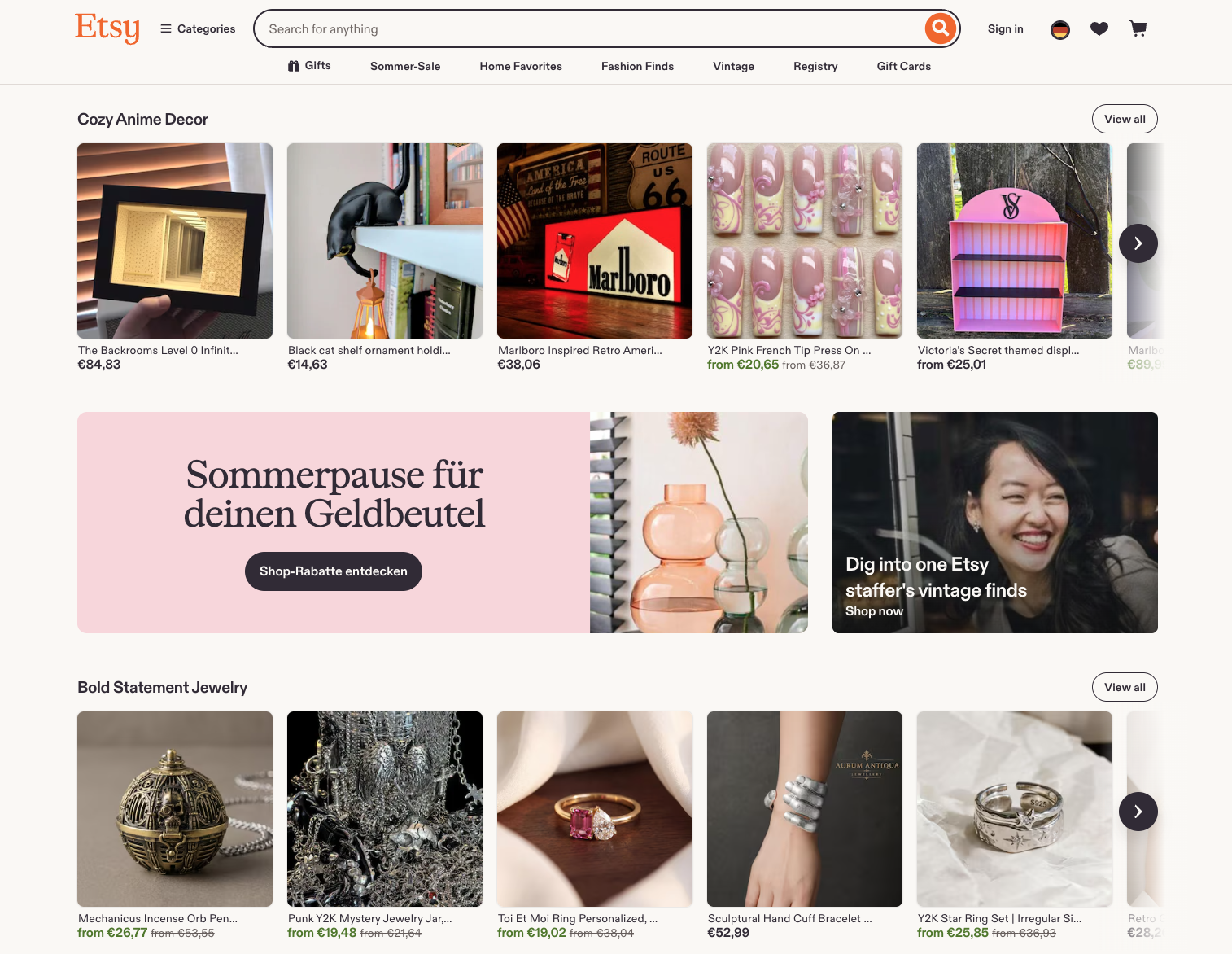
If you sell handmade stuff online, chances are you’ve had at least one moment where you googled “sites like Etsy” out of pure frustration. Maybe it was the fees.
Maybe it was another policy change. Maybe your shop just got buried under thousands of mass-produced listings pretending to be handmade.
Whatever pushed you here, you’re not alone. Searches for Etsy alternatives have exploded over the last few years, and honestly, sellers have good reasons to look around.
Between the listing fees, the transaction fees, the payment processing fees, and the offsite ads you can’t always opt out of, a big chunk of every sale never reaches your pocket.
So in this guide we’ll walk through the best websites like Etsy for sellers in 2026, what each one is good at, and then we’ll cover an option most of these lists completely skip: building your own marketplace like Etsy instead of renting space on someone else’s.

Why sellers look for an alternative to Etsy
Before the list, a quick reality check on why so many makers are hunting for places like Etsy to sell:
Fees add up fast. You pay to list, you pay when you sell, and you pay for payment processing. On smaller items, that stings.
Competition is brutal. Millions of shops means your products can vanish into page ten of search results no matter how good they are.
You don’t own anything. Your shop, your customer relationships, your traffic. It all belongs to the platform. One account suspension and years of work can disappear overnight.
That’s the backdrop. Now let’s look at the actual etsy competitors worth your time.
The best sites like Etsy to sell on in 2026
1. Amazon Handmade
The biggest of all the etsy like websites, purely on traffic. Amazon Handmade sits inside the Amazon ecosystem but only accepts verified artisans, so you’re not competing directly with factory goods. Best for sellers with products that solve everyday problems and can move in volume.
Advantages:
- Massive buyer traffic, people are there to buy right now, not to browse
- Artisan-only approval keeps factory goods out of your category
- Access to Prime shipping and Amazon’s trusted checkout
- The professional selling fee is waived for approved artisans
Disadvantages:
- The 15% referral fee is one of the highest around
- The approval process takes time and not everyone gets in
- Your branding gets swallowed by Amazon’s, buyers remember Amazon, not you
- Amazon’s rules and metrics can feel corporate and unforgiving
2. Shopify
Not a marketplace, but it shows up on every list of etsy alternatives for sellers for a reason. Shopify gives you your own store, your own branding, and your own customer list. Great if you already have an audience, tough if you’re starting from zero.
Advantages:
- Full control over your store’s look, branding, and pricing
- You own your customer list and can email them whenever you want
- No listing fees and no marketplace-style commission on sales
- Huge app ecosystem for anything you want to add later
Disadvantages:
- Zero built-in traffic, you bring every single buyer yourself
- Monthly subscription costs money even in months you sell nothing
- Apps and premium themes can quietly stack up the real cost
- Steeper learning curve than just listing on a marketplace
3. Goimagine
Often called the closest thing to old-school Etsy. Everything on Goimagine is verified handmade, and the company donates profits to children’s charities. If you’re a purist maker tired of competing with dropshippers, this is one of the friendliest online shops like Etsy out there.
Advantages:
- Strictly verified handmade, so no dropshippers undercutting you
- Low fees compared to the big platforms
- Supportive maker community and a feel-good charity mission
- Free plan available to test the waters
Disadvantages:
- Way less traffic than Etsy or Amazon Handmade
- US-focused, so international sellers are mostly out of luck
- Smaller audience means slower sales, especially at the start
4. eBay
Old, huge, and still surprisingly effective. eBay isn’t handmade-focused, but the sheer buyer volume makes it one of the most practical stores like Etsy for testing products, selling supplies, or moving vintage items.
Advantages:
- Enormous buyer base across pretty much every country
- Great for vintage items, craft supplies, and one-off sales
- Visibility can be better than Etsy in less crowded categories
- Auction format lets rare items find their real price
Disadvantages:
- Not handmade-focused, so your crafts sit next to phone cases and car parts
- Bargain-hunter audience that expects low prices
- Fees end up comparable to Etsy once everything is added
- The buyer protection system tends to side against sellers in disputes
5. Big Cartel
A minimalist store builder loved by artists, illustrators, and bands. Like Shopify, you bring your own traffic, but the setup is simpler and cheaper. One of the nicer selling platforms like Etsy for creatives who sell limited runs.
Advantages:
- Free plan for your first few products, genuinely free
- No transaction fees on paid plans
- Clean, gallery-style design that makes visual work shine
- You can set up a store in an afternoon
Disadvantages:
- No built-in audience, same as any standalone store
- Limited features compared to Shopify as you grow
- Not great for large catalogs with hundreds of products
6. Bonanza
A true marketplace like Etsy in structure, with lower fees and less competition. Many sellers use it as a second storefront by syncing their existing listings, which takes minutes and costs almost nothing to try.
Advantages:
- Lower base fees than Etsy
- Easy import tools to sync listings from Etsy or eBay
- Far less competition in most categories
- No listing fees, you only pay when you sell
Disadvantages:
- Much less buyer traffic, don’t expect Etsy-level sales
- Weaker brand recognition, some buyers have never heard of it
- Better visibility often means opting into higher advertising fees
7. Folksy
If you’re in the UK, Folksy is the go-to among websites similar to Etsy. British handmade only, a tight community, and simple pricing. Small pond, but you’re a bigger fish in it.
Advantages:
- UK handmade only, so buyers know exactly what they’re getting
- Much less competition than Etsy
- Simple, transparent fee structure
- Friendly community that actually supports its makers
Disadvantages:
- UK sellers only, everyone else is locked out
- Small buyer base compared to the global platforms
- Fewer marketing and analytics tools
8. Facebook Marketplace
Free to list, no shop needed, and perfect for local sales where shipping would eat your margin. Not really a long-term home for a handmade brand, but as apps like Etsy go, it’s the fastest way to make your first local sale this week.
Advantages:
- Completely free to list, you keep 100% on local sales
- Huge local reach, basically everyone is already on Facebook
- Perfect for bulky items that are too expensive to ship
- Zero setup, you can list something in two minutes
Disadvantages:
- No real storefront or branding to speak of
- Lots of lowballers and no-shows to deal with
- Zero seller protection on local cash deals
- Doesn’t build anything long-term for your business
The problem with every option above
Here’s the thing all these etsy type sites have in common, and it’s the elephant in the room: you’re still building on rented land.
Every marketplace on this list can raise fees, change its algorithm, or suspend your account whenever it wants. You saw it happen with Etsy, and there’s nothing stopping any Etsy competitor from doing the exact same thing once it grows big enough. That’s just how platforms work.
Which brings us to the option that’s genuinely better than Etsy for a certain kind of person.
Option 9: Build your own website like Etsy
Stay with us here, because this isn’t as crazy as it sounds.
If you’ve ever thought “someone should make a fairer version of this,” you can be that someone. WordPress powers over 40% of the internet, and with the right marketplace theme or custom build, you can launch your own site similar to Etsy where independent sellers open shops, list products, and pay commissions to you instead of to a Silicon Valley platform.
This works especially well for niches. A marketplace just for pottery. Just for vintage clothes in your country. Just for digital art, or wedding crafts, or 3D printed goods. Etsy is too big to serve any niche deeply, and that’s exactly the gap a focused, Etsy like marketplace can fill.
And to keep things fair, here’s the honest pros and cons list for this one too:
Advantages:
- You set the fees, charge commissions, subscriptions, featured listings, whatever fits your model
- You own everything: the customers, the data, the traffic, the brand
- Nobody can suspend your account or change the rules on you
- A marketplace with active sellers and buyers is a real asset you can grow and eventually sell
- You can serve a niche deeply in a way Etsy never will
Disadvantages:
- Upfront investment, whether that’s a marketplace theme or a custom build
- You’re responsible for attracting both sellers and buyers, especially early on
- It’s a business to run, not just a shop to list on
At SiteMile, this is literally what we do all day.
We’re a WordPress development and design agency, and we’ve built dozens of multi-vendor marketplaces for clients around the world.
Whether you want a ready-made Etsy clone theme to launch fast on a budget, or a fully custom marketplace designed around your niche, we can take you from idea to a live, working site where sellers can sign up and start listing.
Lets talk and lets see what we can do for you.
So, where should you sell?
If you just want somewhere to list your handmade items besides Etsy, start with Amazon Handmade or Goimagine, and maybe sync a few listings to Bonanza while you’re at it. If you want your own branded store, Shopify or Big Cartel will do the job.
But if you’re the entrepreneurial type who looks at Etsy and sees a business model rather than just a sales channel, building your own marketplace is the one alternative to Etsy that puts you in the owner’s seat instead of the seller’s.
Want to talk it through? Get in touch with SiteMile and tell us about the marketplace you want to build. We’ll tell you honestly what it takes, what it costs, and how fast you can launch.