TLDR: Sitemile can build a custom “Airbnb for motorcycles” platform — a Turo-style motorcycle rental marketplace — in around 3-12 weeks with website and mobile app included, with the price revolving around $5-10k with everything included. Just get in touch with our team to discuss details.
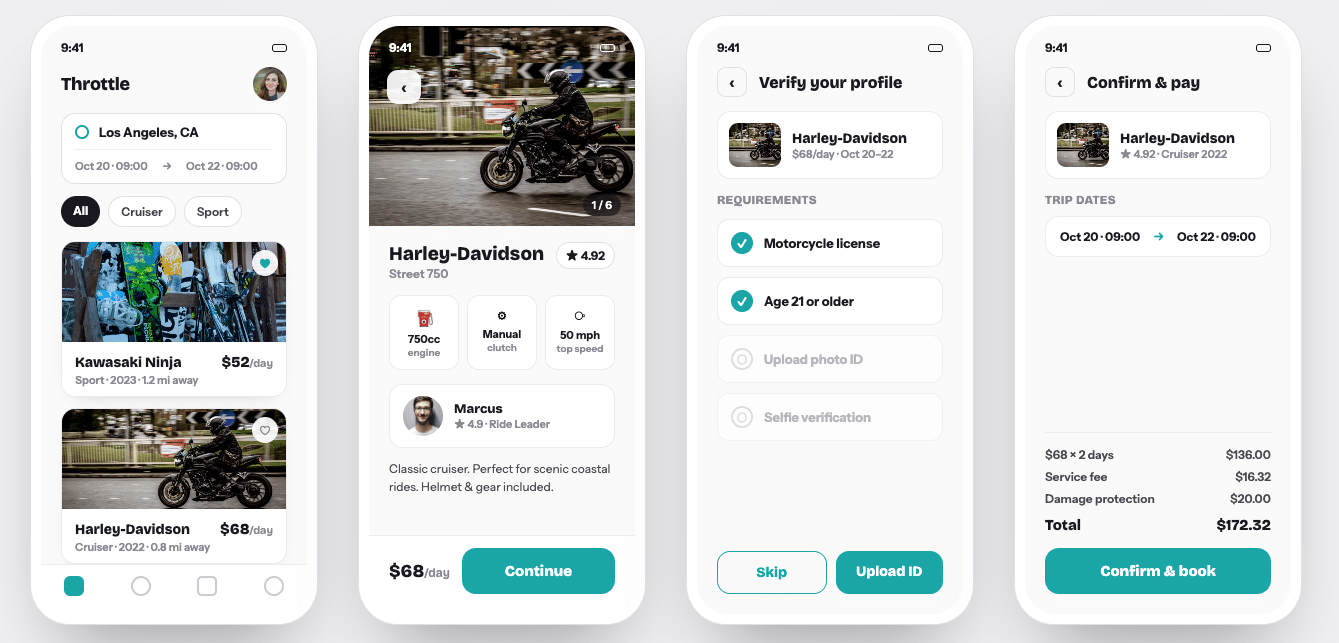
Now continuing with extra details about building your own peer-to-peer motorcycle rental platform, and more details about how we handle building it:
Everyone knows what Turo did for cars, and the same playbook is being run on motorcycles right now. Riders Share, the biggest player in the US, is described by its own customers as “like Turo, but for motorcycles” — bike owners list their machines, verified riders book them, and the platform sits in the middle collecting a commission from the owner and a trip fee from the rider on every booking.
A very good business model; you could call it the Airbnb of motorcycles.
The bikes depreciate in someone else’s garage; the platform keeps the margin. And motorcycles are an even better fit for the model than cars: the average bike sits unused far more than the average car, owners are emotionally attached to their machines but still want them to pay for themselves, and riders travelling to another city can’t exactly bring their bike with them.
That’s why “Turo for motorcycles” and “motorcycle rental app” briefs land in our inbox regularly. And unlike the car-sharing space, this niche is far from saturated:
The entire US market is served by essentially two peer-to-peer players — Riders Share and Twisted Road — plus the traditional Harley-focused EagleRider. Europe, Asia, Latin America, and tourist destinations like Bali, Thailand, and the Canary Islands have no dominant peer-to-peer motorcycle platform at all. And adjacent verticals — scooters, dirt bikes, ATVs, snowmobiles, e-motos — are wide open.
We’ve covered the general car-sharing version of this model in our Turo clone guide; this article is for the reader who wants the two-wheeled version of it.
How the Airbnb for motorcycles model actually works
The flow you’re replicating:
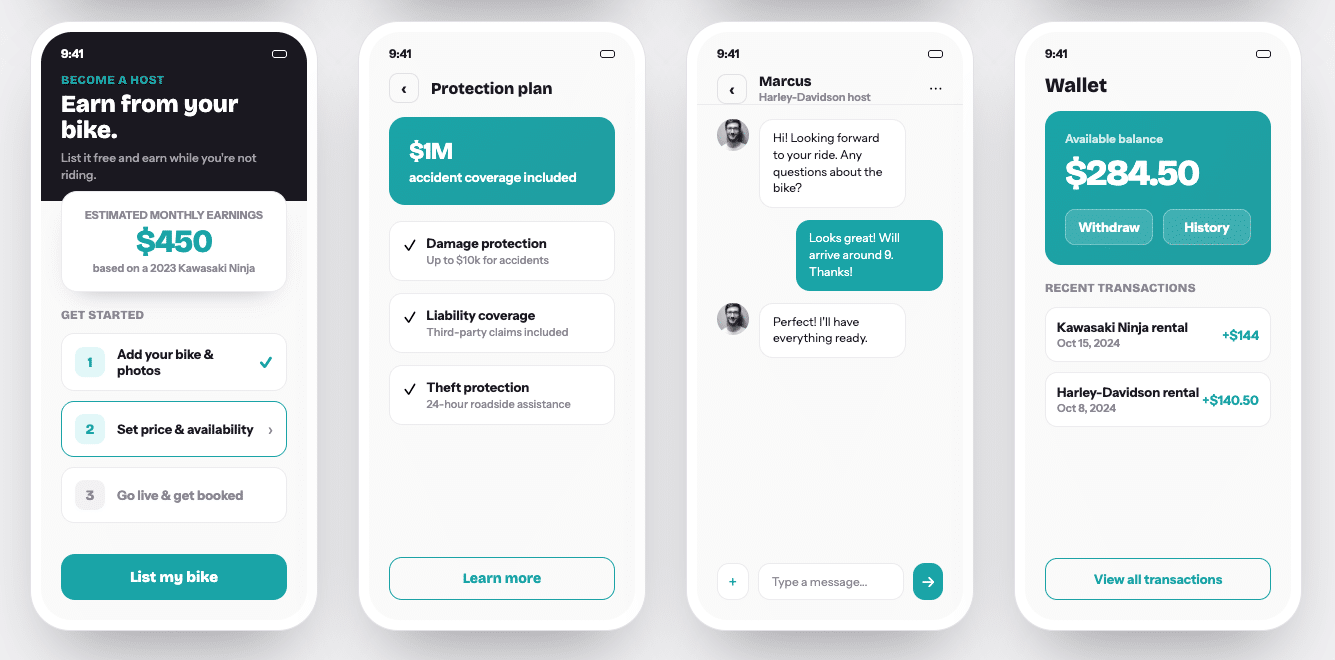
- Owners list their bikes — photos, description, engine size, location, availability calendar, and a daily price. Some platforms suggest pricing based on the model and market; owners can override.
- Owners pick a protection plan. Same clever mechanism as Turo: the plan determines what share of each booking the owner keeps versus what the platform takes. Twisted Road pays owners a 70% share; Riders Share scales it with protection level. The commission structure and the insurance product are the same mechanism.
- Riders get verified — motorcycle license, riding experience, age checks, and screening before they can book. Riders Share even uses machine learning to score renter risk. This gate is what makes owners willing to hand their bike to a stranger — and with motorcycles, the trust bar is higher than with cars.
- Book, pay, pick up. Payment runs through the platform; hand-off happens in person with photo documentation of the bike’s condition, plus a quick walkthrough of the machine’s quirks.
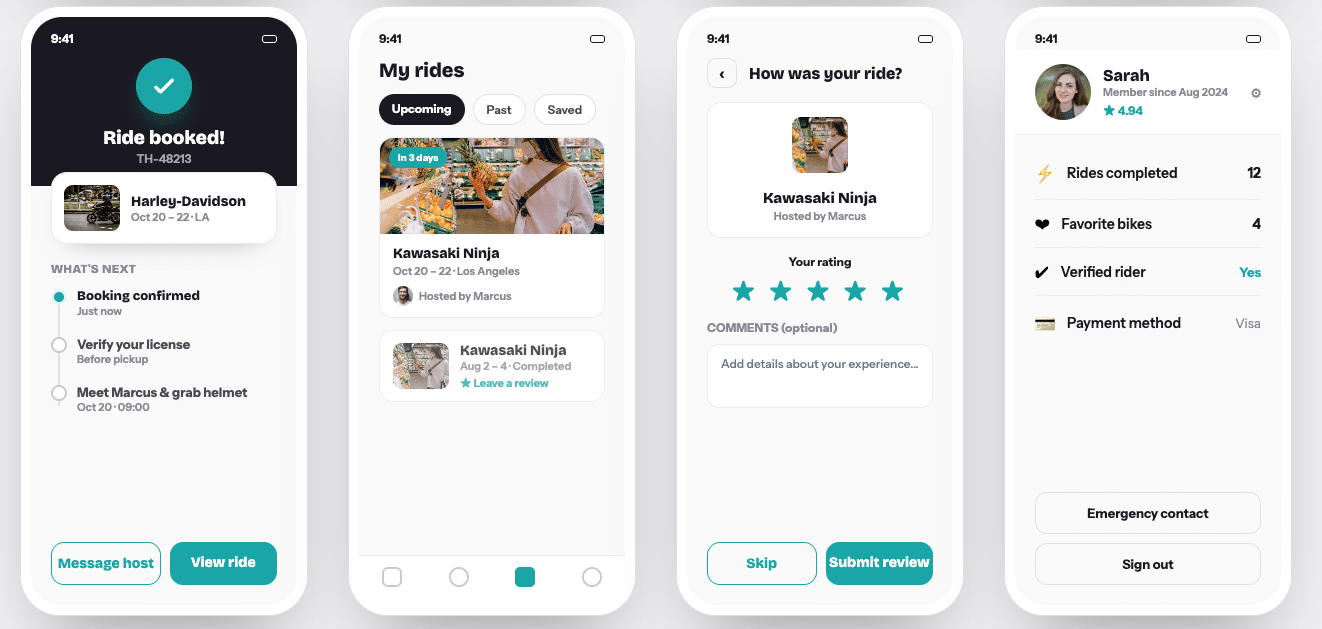
- Trip ends, both sides review, damage claims (if any) go through the platform’s process, and the owner gets paid out.
Revenue comes from both directions: the owner commission scaled by protection plan, plus rider trip fees, and add-ons like helmet and gear rental, luggage, GPS units, delivery to hotels or airports, and prepaid refueling. Gear rental is a genuinely bigger upsell opportunity than anything in the car world — a rider flying in needs a helmet, gloves, and often a jacket, and the platform takes a slice of all of it.
The features your motorcycle rental platform needs
For riders:
- Search by location and dates, with filters for bike type (cruiser, sport, touring, adventure, scooter), engine size, brand, and price
- Listing pages with photo galleries, owner profiles, reviews, and transparent total pricing
- Motorcycle license verification and riding-experience screening at signup
- Booking, secure payment, and in-app messaging with owners
- Trip management: check-in photos, extensions, roadside assistance access, and support
For owners:
- Listing builder with availability calendar, pricing controls, and minimum rider-experience requirements
- Booking requests vs instant-book toggle, plus rider screening visibility — owners approving each rider is standard in this niche
- Earnings dashboard, payout history, and tax summaries
- Claims and incident reporting with photo evidence
- Multi-bike tools for the small fleet operators and rental shops that supply an outsized share of listings — build for them early and your supply problem shrinks
For you (the admin):
- Commission and protection-plan configuration
- Verification pipeline management and manual review queues — including license class checks, which matter more than in car sharing
- Dispute and claims workflows
- Analytics: bookings, utilization, revenue per bike, top markets
Optional but powerful: gear rental and route content. Helmet/gear add-ons at checkout raise average order value, and curated riding-route content around your listings is exactly how the incumbents win their SEO traffic. Both belong in the upper tier of a build, not the MVP.
The honest part: insurance and protection
Every serious conversation about a motorcycle rental marketplace arrives here, so let’s not bury it. The single hardest piece of this business isn’t software — it’s what happens when a rider drops someone’s bike. Motorcycle risk profiles are tougher than cars, which is exactly why the space has fewer competitors — and why the ones who solve it win. You have real options, and the right one depends on your market:
- Partner with an insurer. The Riders Share approach: trip-embedded coverage packaged into protection plans that also set your commission. In most markets there are insurers and insurtech brokers who write embedded rental coverage — this is a business-development task to run in parallel with the build.
- Deposit-and-agreement model. Common for launches in markets where embedded motorcycle insurance isn’t yet available: security deposits held through the platform, binding rental agreements between owner and rider, and verification strict enough to keep bad actors out. Many regional platforms started here and added insurance partnerships once volume justified them.
- Fleet-carried commercial coverage. For platforms targeting rental shops, tour operators, and dealerships rather than private individuals — your suppliers already carry commercial rental policies, and your platform is their booking channel. This sidesteps the P2P insurance question entirely and is the fastest compliant route to market in many countries, especially tourist destinations.
We build the platform side of all three — protection-plan logic, deposits, claims workflows, document collection — but pick your insurance strategy before you build, because it shapes the product. The software serves the business decision, not the other way around.
How much does an Airbnb for motorcycles app cost?
Our packages run from $5,500 to $50,000 USD:
- From $5,500 — the complete starter package: website plus native iOS and Android apps, covering bike listings with calendars, search and filters, rider verification, bookings, payments, messaging, reviews, and your commission engine. Built on our proven marketplace stack, published to both app stores, full source code handed over. This is the validate-your-market tier — one city, one country, or one bike vertical.
- Up to $50,000 — complex implementations: insurance-partner API workflows, advanced ID/license verification services, dynamic pricing engines, gear-rental add-on modules, fleet-owner dashboards, GPS tracker integrations, and multi-region, multi-currency setups.
A conventional agency quotes $80,000–$150,000+ for the same scope over six or more months.
Our pricing works because we start from marketplace software that already runs live platforms — the same foundation behind the Turo clones and transportation marketplaces we build — and customize from there. And as always: your brand, your market, no copying of anyone’s design or trademarks.
We are also using WordPress as backend for an affordable cost or for more robust builds we use PHP Laravel as backend, for the API and native mobile apps which are published in the appstore and google play store.
Want an exact quote? Schedule a discovery call and we’ll map your feature list and insurance strategy to a fixed price.
Where a motorcycle rental marketplace wins in 2026
- Any country outside the US. Riders Share and Twisted Road are US-only in practice. Europe has fragmented aggregators but no true peer-to-peer leader; Southeast Asia, Latin America, and the Middle East have essentially nothing. A local platform with local payments, local language, and a local insurance route is the classic play.
- Tourist destinations. Bali, Thailand, Vietnam, the Greek islands, the Canaries — enormous motorcycle and scooter rental demand, currently served by walk-in shops with no booking layer. A fleet-first platform aggregating those shops is the fastest launch there is.
- A bike vertical. Dirt bikes, ADV/touring bikes with gear packages, scooters and e-motos in cities, snowmobiles and ATVs seasonally. Same architecture, thinner competition, often higher-value bookings.
- The experience angle. Guided-ride add-ons, route packages, and event rentals (bike weeks, rallies, track days) — the incumbents barely touch these, and they double booking value.
Frequently asked questions
How much does it cost to build an app like Riders Share or Twisted Road?
With SiteMile, from $5,500 for the complete website-and-apps package, up to $50,000 for complex builds with insurance integrations, verification services, and fleet dashboards.
Request a quote with your spec for an exact figure.
How does an Airbnb for motorcycles make money?
Owner commissions (typically scaled to protection level), rider trip fees, gear and helmet rental, delivery fees, and paid extras — revenue from both sides of every booking, on bikes you don’t own or maintain.
What about insurance — is a motorcycle sharing platform even legal to run?
Peer-to-peer vehicle sharing operates legally in many countries, but insurance and regulatory setup varies by jurisdiction. Embedded insurance partnerships, deposit-based models, and fleet-supplier models are the three standard routes, and local legal advice on your specific market is a launch prerequisite, not an afterthought. We build the platform to fit whichever route you take.
Do riders need special verification?
Yes — and it’s stricter than car sharing. Motorcycle license class checks, riding-experience screening, and age gates are standard, and owners typically get final approval on each booking request. We build the full verification pipeline into every package.
How long until launch?
The starter package typically launches in weeks, with app store review adding some time on the mobile side — against six-plus months for a from-scratch build.
Launch your motorcycle rental platform
The model is proven — riders already call the market leader “Turo for motorcycles,” and outside a couple of US players the whole world is underserved. Pick your market and your insurance route, and we’ll deliver the rest: website, native apps, and full source code included.
Get in touch with our team today and let’s scope your Airbnb for motorcycles.