Search for “cheap SEO report” and you’ll find everything from free instant scans to $2,000 professional audits — often described with the same words.
That’s because “SEO report” actually means two different things, and knowing which one you need will save you real money.
Quick answer: a monthly SEO report (the ongoing performance report showing traffic, rankings, and work completed) should cost you nothing extra — it must be included in any legitimate SEO retainer.
A one-time SEO audit report (a diagnostic of your site’s problems and how to fix them) costs anywhere from free (automated tools) to $100–$500 (basic/freelancer) to $500–$2,000+ (professional, manual, prioritized).
If someone tries to sell you a standalone “monthly report” as a product, or a $50 “professional audit,” walk away — we’ll explain why below.
Let’s break down both types, what a good one contains, and what a fair price looks like.

The Two Kinds of SEO Reports
1. The Monthly SEO Performance Report
This is the recurring report you receive from an agency or freelancer running your SEO campaign. Its job is to answer two questions: is this working? and what did you actually do this month?
A proper monthly report includes:
- Organic traffic — sessions from search, compared to last month and last year
- Keyword rankings — movement on your target keyword list, not cherry-picked wins
- Conversions — calls, form fills, and sales attributed to organic search, because traffic without leads is decoration
- An itemized work log — pages optimized, content published, links earned, fixes shipped
- Analysis and next steps — what the numbers mean and what’s planned next month
The work log is the part that matters most and the part cheap providers omit. A report full of graphs but empty of completed tasks is how agencies bill retainers for doing nothing. This is exactly why we tell readers in our guide to affordable SEO packages for small businesses to ask for a sample report before signing anything — it’s the fastest quality test that exists.
What it should cost: $0 on top of your retainer. Reporting is part of the service, not an add-on. Any provider charging separately for telling you what they did with your money has told you everything you need to know about them.

2. The One-Time SEO Audit Report
An audit report is a diagnostic. Someone examines your site and delivers a document explaining what’s blocking your rankings — technical problems, content gaps, on-page issues, link profile weaknesses — ideally as a prioritized fix list.
This is the report people usually mean when they search for SEO report pricing, and it’s where prices genuinely vary. Here’s the honest breakdown:
| Price | What it really is | What you get |
|---|---|---|
| Free | Automated tool scan (or agency lead-gen) | A surface-level list of issues: missing meta tags, slow pages, broken links. No context, no prioritization. Useful as a starting point, not a plan. |
| $100–$500 | Freelancer or tool-assisted audit | Mostly automated crawl data with light human review. Catches the obvious problems on small sites. Rarely includes strategy. |
| $500–$2,000 | Professional manual audit | A human expert reviews your technical setup, content, competitors, and links, and delivers a prioritized action plan. This is the sweet spot for most small business sites. |
| $2,000–$5,000+ | Comprehensive / enterprise audit | Deep analysis for large e-commerce sites, international sites, or sites with thousands of pages. Overkill for a typical small business. |
The price scales with your site, not your ego: a 10-page local business site does not need a $3,000 audit, and anyone who quotes you one is upselling. Conversely, a large WooCommerce store with thousands of product pages can’t be meaningfully audited for $150 — there’s simply too much to crawl, analyze, and prioritize.
Why Cheap SEO Reports Are Usually Worthless
The $20–$100 “SEO report” market runs almost entirely on automated tool exports. Someone runs your URL through crawling software, slaps a logo on the PDF, and sends you 40 pages of raw findings. Three problems with that:
You could generate the same thing yourself for free. The tools these sellers use have free tiers. You’re paying for a middleman’s logo.
Data without prioritization isn’t a plan. A raw crawl might flag 200 “issues” — 190 of which don’t matter. The entire value of a real audit is a human saying “these three things are costing you rankings; fix them in this order.” That judgment is what the $500–$2,000 tier buys.
Cheap reports are usually sales bait. Many free or cheap reports are engineered to look alarming — walls of red warnings — so you’ll panic-buy a monthly package from the seller. An honest report distinguishes between critical issues and cosmetic ones.
The pattern mirrors what we covered about cheap SEO services generally: below a certain price, the economics only work through automation, and automation can’t do the part you’re actually paying for. It’s the same reason business owners on forums consistently warn against the bottom of the market — something we dug into when we researched the best SEO companies for small businesses according to Reddit.
How to Get a Useful SEO Report for Free (Really)
Before paying anyone, exhaust the genuinely free options — they’re better than any $50 report:
Google Search Console. Free, from Google itself, and the single most valuable SEO reporting tool that exists. It shows your actual queries, impressions, clicks, positions, and indexing problems. If your SEO provider’s monthly report contradicts what Search Console shows, believe Search Console.
Google Analytics. Tracks what search visitors do after they land — the conversion half of the picture.
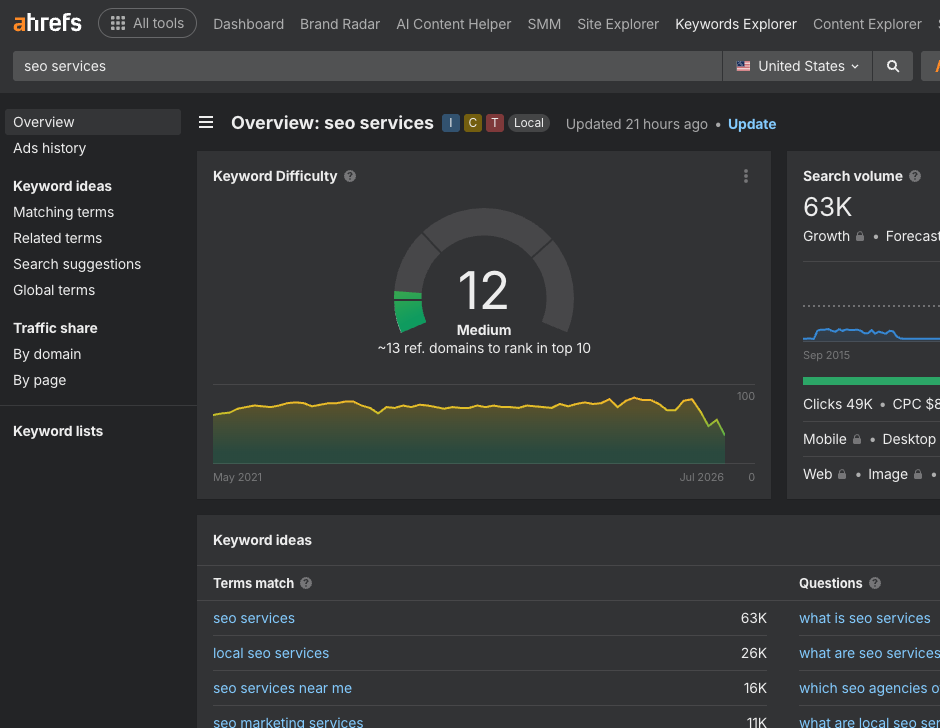
A free automated scan. Fine as a first pass to catch glaring technical issues. Just read it knowing its limits: no prioritization, no strategy, and an incentive to alarm you.
If those free tools show healthy fundamentals and steady growth, you may not need a paid audit at all. If they show stagnant traffic, indexing errors, or a site that’s been flat for a year, that’s when a professional audit earns its fee — because the problem is no longer obvious.
What to Check Before Paying for an SEO Audit
Five things separate a real audit from an expensive PDF:
- Ask for a sample. Any credible auditor has an anonymized example. Look for prioritization and plain-language explanations, not tool screenshots.
- Confirm it’s manual. Ask directly what portion is human analysis versus tool export. Honest providers answer specifically.
- Check it includes an action plan. “Here’s what’s wrong” is half a deliverable. “Here’s what to fix, in order, and why” is the whole thing.
- Ask who implements the fixes. An audit that ends with “give this to your developer” quietly adds a second bill. This is why we handle audits and implementation together — as WordPress developers, we fix what we find instead of handing you homework. Ongoing fixes and monitoring matter more than the document itself, which is a point we’ve made before about why ongoing SEO and website maintenance matter.
- Match audit depth to site size. Pay for the tier your site actually needs — see the table above.
Frequently Asked Questions
How much does a monthly SEO report cost? Nothing, if you’re doing it right — monthly reporting must be included in any SEO retainer or package. Standalone “monthly report” products are middlemen reselling tool exports.
How much does a professional SEO audit cost? For most small business websites, $500–$2,000 buys a genuine manual audit with a prioritized action plan. Large e-commerce or enterprise sites run higher. Under ~$100, you’re buying an automated scan.
Are free SEO reports accurate? The data is usually accurate; the interpretation is missing. Free scans list issues without telling you which ones matter, and many are designed to alarm you into buying services.
What should be in an SEO report? Monthly report: organic traffic, keyword rankings, conversions, an itemized work log, and next steps. Audit report: technical, on-page, content, and link findings — prioritized into an action plan.
How often should I get an SEO audit? A full audit once a year, or after major events: a redesign, a migration, a traffic drop, or before starting a new SEO campaign. In between, monthly reporting covers you.
Can I do my own SEO report? Yes — Google Search Console plus Google Analytics gives you 80% of what a monthly report contains, free. What you can’t easily replicate is expert prioritization, which is what paid audits are actually for.
The Report Is Included. So Is Everything Else.
Every one of our SEO packages includes monthly reporting with a full work log as standard — traffic, rankings, conversions, and exactly what we did, every month. And because we’re a WordPress development agency, when an audit finds problems, we fix them ourselves instead of mailing you a PDF.