So you want to build an app like Airtasker. Good instinct — the task marketplace model is one of the few gig-economy formats that’s genuinely proven at scale, and yet most of the world still doesn’t have a strong local player.
Airtasker dominates Australia, but the US, most of Europe, Asia and Latin America remain wide open for regional versions of the same idea.
This guide walks you through everything: how the Airtasker model actually works, the features your platform needs, the tech stack options (including how to do it with WordPress for a fraction of the usual cost), realistic budgets, and how to launch without burning six figures before your first task is posted.
Get a ready made airtasker clone from our team, and lets customize it together.
What is Airtasker, and why does the model work?
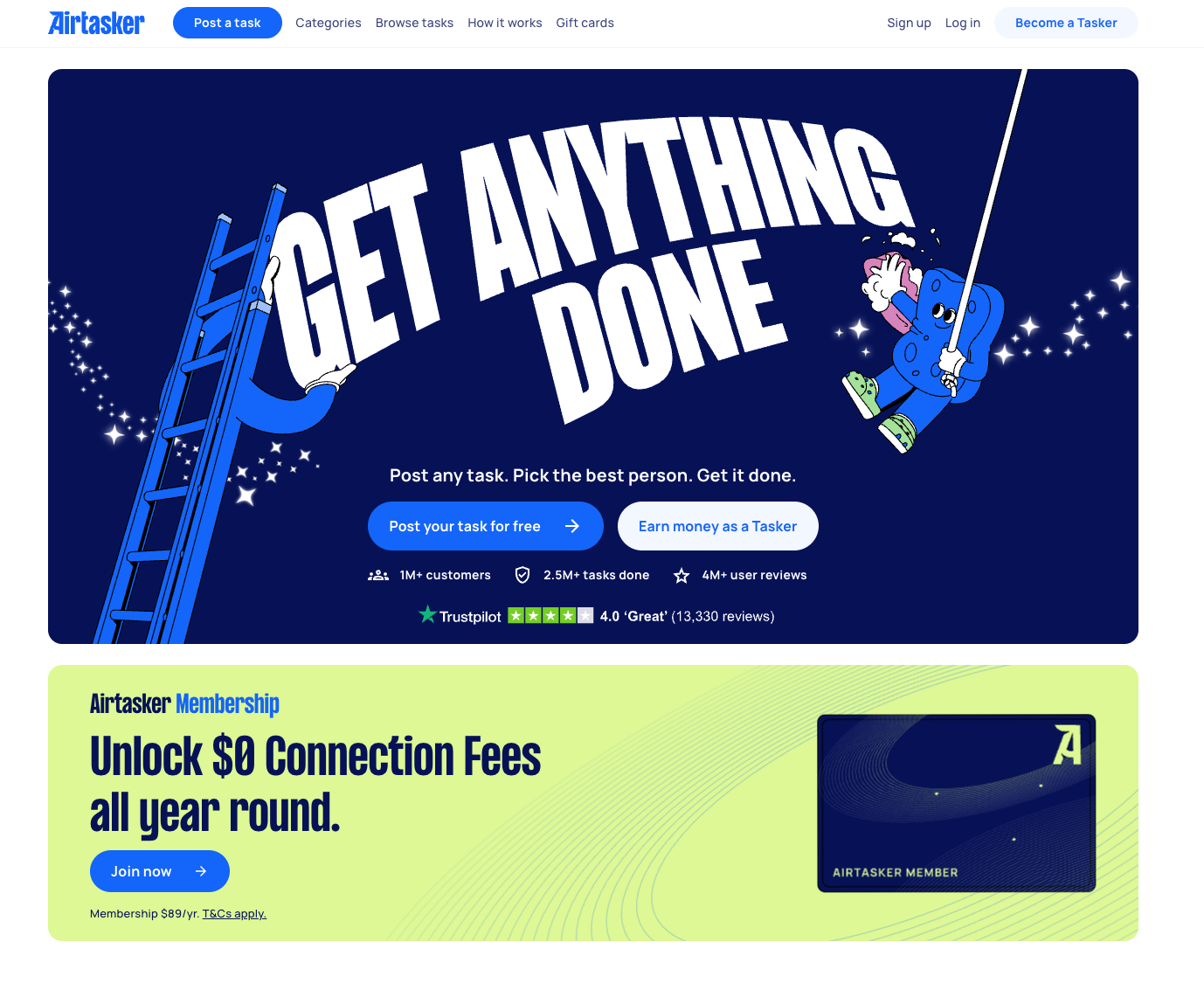
Airtasker is a two-sided task marketplace founded in Sydney in 2012. One side posts everyday tasks — furniture assembly, cleaning, moving help, deliveries, handyman jobs, even digital work. The other side, the “taskers,” bid on those tasks and complete them for money.
What makes the business so attractive is that the platform owns nothing. No vans, no tools, no employees doing the work.
Airtasker simply connects demand with supply and takes a service fee on every transaction that flows through it. That’s why the model scaled from an apartment idea to a publicly listed company — and why founders keep trying to replicate it in markets Airtasker never entered.
The key mechanic to understand is the task auction. Unlike browse-and-book platforms, Airtasker lets the customer name their budget upfront (“assemble a wardrobe, Saturday, $80”), and taskers compete for the job with offers at, under, or above that budget. The customer then picks a winner based on price, reviews, and completion rate. That budget-anchored bidding flow is Airtasker’s signature — and it’s what you’ll be rebuilding.
Worth knowing before you commit to this exact flow: Airtasker’s auction model is only one of three proven task-marketplace formats. TaskRabbit uses direct booking at hourly rates, and Thumbtack sells leads to professionals.
We’ve broken down whether you can launch a Thumbtack clone with WordPress and how to launch a TaskRabbit clone separately — pick the flow that fits your market, or hybridize.
Step 1: Research your market and pick a niche
The single biggest reason task marketplaces fail is not technology — it’s launching too broad. Every category, every city, day one. That spreads your tasker supply so thin that customers post tasks into silence, get no offers, and never come back.
Do the opposite. Pick one of these two proven entry strategies:
Geography-first: launch the full Airtasker experience (10–15 categories) in a single city or region where you can personally recruit taskers. This is the classic “be Airtasker where Airtasker isn’t” play — a local-language, local-payments task marketplace for your country.
Vertical-first: launch one category deeply — handyman work, cleaning, moving, garden work — across a wider area. A bidding marketplace for a single vertical is a real business on its own.
Part of your research should be studying the existing players. We’ve mapped out the current landscape in our roundup of sites like Airtasker — the gaps in that list are literally your market opportunity. If your country or your vertical isn’t served by anyone on it, you’ve found your wedge.
Step 2: Understand how the business makes money
Before writing a line of code, decide your revenue model. Task marketplaces monetize in four main ways:
- Service fee on tasker earnings — the standard model. A percentage is deducted from what the tasker earns on each completed job. Airtasker uses a sliding scale where high-volume taskers pay a lower rate.
- Customer-side booking fees — a small flat or percentage fee added on the posting side.
- Tasker subscriptions — a flat monthly fee for taskers instead of (or alongside) percentage cuts. This is worth serious consideration: percentage fees are the number one complaint on every gig platform, and a fairer deal for taskers is a powerful weapon for pulling supply away from incumbents.
- Featured placement — taskers or tasks pay for visibility.
Most successful platforms start with the service fee model because it aligns your revenue with marketplace liquidity, then layer in the others.
Step 3: Define the features your Airtasker app needs
Think of the platform as three products in one: the customer experience, the tasker experience, and your admin control panel.
Customer-side features
- Registration via email, phone, or social login
- Task posting with description, photos, category, location, date, and a budget field
- An offer inbox to compare bids, tasker profiles, reviews, and completion rates side by side
- Secure upfront payment with escrow-style release when the task is complete
- In-app messaging, plus public task Q&A so taskers can ask questions before bidding (an underrated feature that dramatically improves bid quality)
- Reviews and ratings after completion
Tasker-side features
- Browse and filter available tasks by category, distance, and budget
- Offer-making tools with an active / won / completed dashboard
- Rich profiles with skills, verification badges, and portfolio
- Earnings tracking and payout management
- Push and email alerts for new tasks matching their skills and area — for a gig marketplace, this is the feature that drives fill rate, because taskers live on their phones
Admin features
- Category, commission tier, and fee configuration
- User verification, moderation, and dispute resolution tools
- Analytics: tasks posted, fill rate, revenue by category and region
One metric deserves an obsession from day one: fill rate — the percentage of posted tasks that receive at least one offer. Everything about your launch plan should be designed to keep that number high, even if it means starting embarrassingly small.
Step 4: Choose your tech stack (this is where budgets are won or lost)
Here’s where most guides quietly steer you toward a $100,000+ custom build. The truth is there are three viable paths, and the right one depends on your stage:
Option A: WordPress (fastest and cheapest MVP)
Yes, you can genuinely run a task-bidding marketplace on WordPress. A purpose-built service marketplace theme like SiteMile’s Pricerr already handles task posting, bidding, secure payments, messaging, and reviews out of the box — meaning your build is customization (branding, categories, fee model, the Airtasker-style auction flow) rather than from-scratch engineering. This is how you get a live, revenue-capable marketplace website from around $3,500 instead of five figures.
The WordPress route is the validate-your-market option: launch in weeks, prove that customers post tasks and taskers bid on them, and only then invest in heavier infrastructure.
Option B: Laravel (custom PHP build for scale)
When you outgrow the MVP or want native mobile apps from day one, a custom Laravel build gives you full architectural control — custom matching logic, tiered commission engines, multi-region support — while React Native covers iOS and Android from one codebase. This is the “website + apps” package territory, typically starting around $5,500–$6,000 rather than the $80,000–$150,000 a conventional agency quotes for the same scope.
Option C: Fully custom scripts
For complex implementations — background-check integrations, insurance workflows, AI-driven matching — custom development on top of either stack takes you as far as your spec demands, with budgets scaling up toward $50,000 depending on requirements.
The strategic point: the stack should follow the business stage, not the other way around. Start on WordPress, migrate to Laravel when traction demands it, and spend the money you saved on recruiting your first hundred taskers — because supply, not software, is what makes a marketplace live or die. Our full Airtasker clone guide breaks down these tiers, timelines, and what’s included at each level.
Step 5: Build the MVP
Whatever stack you choose, resist the urge to build everything. Your minimum viable product needs exactly one thing to work flawlessly: the core loop of post task → receive offers → accept → pay → review. That’s it.
Features that feel essential but can wait for version two: loyalty programs, advanced gamification, AI recommendations, multi-language support (unless your market demands it at launch), and native apps if a mobile-responsive website can carry your first city.
A focused MVP on a ready-made marketplace stack launches in roughly 4–12 weeks from kickoff to live — compare that with the 6+ months of a from-scratch build, during which your market window is closing and your budget is burning.
Step 6: Solve the chicken-and-egg problem
Every marketplace founder faces it: customers won’t come without taskers, taskers won’t come without tasks. The playbook that works:
- Recruit supply first, manually. Before launch, personally sign up 50–100 taskers in your launch city or vertical. Facebook groups, local gig communities, and existing freelancers on other platforms are your hunting grounds.
- Seed demand yourself. Post real tasks in the early days. Pay for them. A tasker’s first week on your platform decides whether they ever open the app again.
- Offer taskers a better deal than incumbents. Lower fees or a flat subscription is the sharpest recruiting message available. Supply is the whole game — customers follow taskers, not the other way around.
- Stay small until fill rate is healthy. Only expand to the next city or category when most posted tasks reliably get offers.
How much does it cost to build an app like Airtasker?
Pulling the numbers together:
| Approach | Typical cost | Timeline |
|---|---|---|
| WordPress MVP website | from $3,500 | a few weeks |
| Website + iOS/Android apps (Laravel + React Native) | from $5,500–$6,000 | 4–12 weeks |
| Complex custom implementation | up to $50,000 | depends on spec |
| Conventional agency from-scratch build | $80,000–$150,000 | 6+ months |
The pattern is obvious: ready-made marketplace stacks compress both cost and time by an order of magnitude, leaving your budget for the part software can’t solve — building liquidity. For a deeper look at packages and what’s included, see our marketplace app development services.
Frequently asked questions
Can I really build an Airtasker-style app with WordPress?
Yes. The core Airtasker mechanics — task posting, bidding, escrow payments, messaging, reviews — are all handled by purpose-built marketplace themes. WordPress is the right choice for validating the market; you can move to a custom Laravel build once traction justifies it.
How long does it take to launch?
An MVP website typically goes live in a few weeks. Adding native iOS and Android apps extends the timeline mostly due to app store review, but you’re still looking at 4–12 weeks total rather than the 6+ months of a fully custom build.
Do I need mobile apps at launch?
Not necessarily for customers — a responsive website handles task posting fine. But apps matter enormously for taskers, because push notifications about new nearby tasks are the main driver of fill rate. Many founders launch web-first, then add apps once the marketplace has liquidity.
Should I copy Airtasker exactly?
Copy the proven flow, not the brand. Your design, name, and trademarks must be your own — what you’re replicating is the budget-anchored auction mechanic and the two-sided marketplace structure, adapted to your market. Differentiating on the fee model (for example, flat tasker subscriptions instead of percentage cuts) is often smarter than a pixel-perfect copy anyway.
What’s the difference between building an Airtasker clone and a TaskRabbit or Thumbtack clone?
The marketplace structure is similar; the matching flow differs. Airtasker is an auction (customer posts a budget, taskers bid), TaskRabbit is direct booking at hourly rates, and Thumbtack is pay-per-lead. All three can be built on the same underlying stack — the choice comes down to which flow fits your market and category.
Ready to build your task marketplace?
The task economy keeps growing, the auction model is proven all the way to a stock exchange listing, and most of the world’s map is still empty. Pick your city or your vertical, start with a lean build, and put your budget into supply.
If you’d rather skip six months of custom development, our team builds Airtasker-style marketplaces on WordPress and Laravel with full source code handed over — see how the Airtasker clone package works or get in touch to scope your project.