Short answer: neither is “better”, because they run on opposite models. Airtasker is an auction: you post a task with a budget and workers bid for it, so it wins on price competition and flexibility.
TaskRabbit is direct booking: you browse workers’ hourly rates and hire one, so it wins on speed and predictability. Which one is better for you depends on whether you value control over price (Airtasker) or control over time (TaskRabbit) and, honestly, on where you live, since their coverage barely overlaps.
Let’s break down the differences properly — for customers, for workers, and for the founders quietly researching which model to copy.
Two platforms, two opposite philosophies
TaskRabbit is the older platform, founded in San Francisco in 2008 and acquired by IKEA in 2017. Its model is browse-and-book: taskers list hourly rates for categories like furniture assembly, mounting, moving, and cleaning; you pick one based on their rate, reviews, and availability, and book them directly.
The platform charges clients a service fee on top of the tasker’s rate. It’s strongest in the US and Canada, with a presence in the UK and parts of Europe — and, unsurprisingly given its owner, it’s deeply integrated with IKEA furniture assembly.
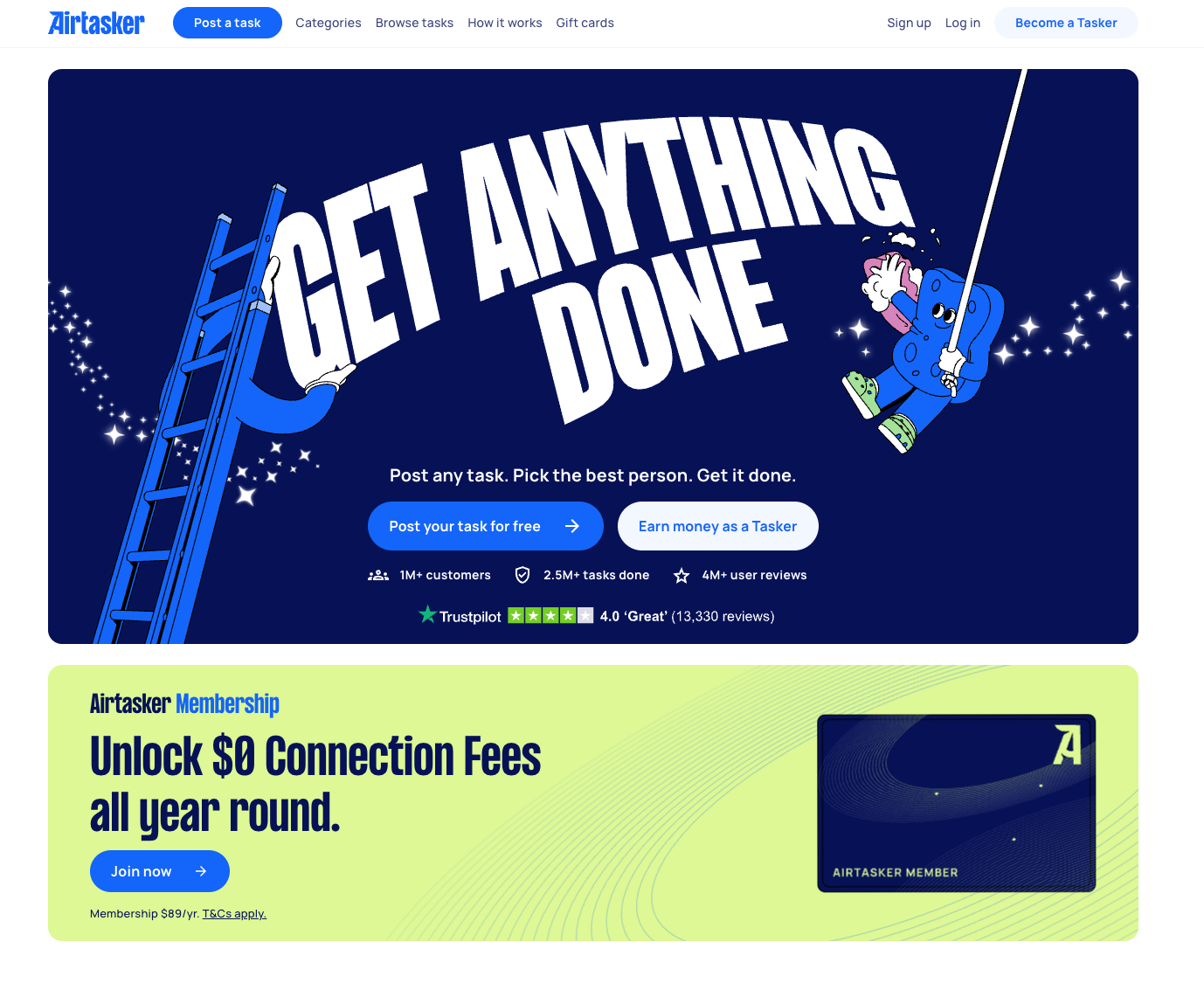
Airtasker launched in Sydney in 2012 and is now a public company on the Australian stock exchange. Its model is a reverse auction: you post a task with a description and a budget (“assemble a wardrobe, Saturday, $80”), local taskers make offers at, under, or above that budget, and you choose based on price, reviews, and completion rate. Payment is held securely and released when the job is done, and revenue comes mainly from a commission deducted from the tasker’s earnings.
It dominates Australia and is growing in the UK and US.
Same category of app. Completely different mechanics.
Which is better for customers?
Choose Airtasker-style bidding when price matters and the task is unusual. The budget-anchored auction makes workers compete for your job, which typically works in your favor on price — and because you define the task, it handles weird, one-off, and even digital jobs that don’t fit neat hourly categories.
The trade-off: you wait for offers to come in, and quality filtering is on you.
Choose TaskRabbit-style booking when speed matters and the task is standard. For a common job — mount a TV, assemble flat-pack furniture — browsing rates and booking someone for tomorrow at 10am is simply faster.
The trade-off: hourly rates plus a client-side service fee usually cost more than a competitive bid, and you’re limited to the categories the platform defines.
And the practical reality that overrides all of it: coverage decides for most people. In Australia, Airtasker is the default and TaskRabbit barely registers. In most US cities, it’s the reverse. Check tasker density in your area before anything else — a marketplace with no local supply is better at nothing.
Which is better for workers?
For taskers, the models feel very different day to day. On TaskRabbit you set your hourly rate and clients come to you — steadier and more predictable once your profile is established, but slower to start because new taskers with no reviews rarely get picked.
On Airtasker you actively bid for posted tasks — more hustle per job, and the commission comes out of your earnings on a sliding scale (roughly 20% for new taskers, dropping toward 10% as your track record grows), but it’s much easier to win your first jobs by bidding sharp, and the open categories let you sell skills TaskRabbit doesn’t list, from gardening to graphic design.
Rule of thumb: TaskRabbit rewards established pros in standard categories; Airtasker rewards hustlers, beginners building a reputation, and anyone whose skills don’t fit a dropdown menu. Many gig workers in overlap markets simply run both.
Which is the better business?
Here’s the comparison the other versus-articles skip. Both models print money at scale, but differently:
- Airtasker’s auction monetizes completed transactions (commission plus booking fees — an overall take of around 21% of task value at maturity) and scales across unlimited categories, because users set prices and the platform never needs to know what any job “should” cost.
- TaskRabbit’s booking model is operationally simpler — no auction logic, just calendars and rates — and converts faster for standard tasks, but it needs curated categories and enough vetted supply to make browsing useful from day one.
Neither company owns most of the world’s map: between them they seriously cover Australia, the US, and a handful of European markets, leaving the task-marketplace model unclaimed almost everywhere else.
That gap is exactly why both models get cloned — we’ve written a full guide on how to build an Airtasker app covering the auction model, and a companion piece on launching a TaskRabbit clone for the booking model. If you’re weighing the two as a founder, the honest guidance is: bidding suits broad, multi-category marketplaces and price-sensitive markets; direct booking suits focused verticals where speed and trust win. And the two aren’t mutually exclusive — a platform can launch with one flow and add the other, which is a conversation we have in most Airtasker clone discovery calls.
The verdict
- For a standard task, done fast, in the US: TaskRabbit.
- For the best price, an unusual task, or anything in Australia: Airtasker.
- For gig workers: TaskRabbit if you’re an established pro in its core categories; Airtasker if you’re starting out, hustling, or selling non-standard skills. Both, if your city has both.
- For founders: it’s not either/or — it’s which flow fits your market. The auction scales wider; the booking flow converts faster.
Both are also just two players in a bigger field — Thumbtack, Handy, Oneflare, and a long tail of regional platforms all attack the same problem with different mechanics. We’ve mapped the full landscape in our roundup of sites like Airtasker if you want the complete picture.
Frequently asked questions
Is TaskRabbit available in Australia?
TaskRabbit has no meaningful presence in Australia, where Airtasker is the dominant task marketplace. Conversely, Airtasker’s US footprint is young and concentrated in select cities, while TaskRabbit covers most major US metros.
Which is cheaper, Airtasker or TaskRabbit?
For customers, Airtasker’s bidding usually produces lower prices for the same job, since workers compete against your stated budget. TaskRabbit’s hourly rates plus client-side service fees typically total more — the premium buys speed and simplicity.
Do Airtasker and TaskRabbit work the same way?
No — that’s the core difference. Airtasker is a reverse auction where you post a budget and receive offers. TaskRabbit is direct booking where you browse hourly rates and hire immediately.
Can I build my own version of these platforms?
The models themselves aren’t proprietary — what’s protected is each company’s brand and design. Founders regularly launch their own branded task marketplaces on either flow, usually for a country or niche the big two don’t serve. Our guide to building an Airtasker-style app walks through the whole process, including costs and tech stack options.