Quick answer: Airtasker makes money primarily through a service fee deducted from taskers’ earnings on every completed task, using a sliding scale that starts around 20% and drops to roughly 10% for its most reliable, high-volume taskers — plus booking fees on the customer side.
In its most recent full financial year (FY25), that model produced A$52.6 million in group revenue on A$208.7 million of gross marketplace volume, at a 95.8% gross profit margin.
In other words: for every dollar of work that flows through the platform, Airtasker keeps about 21.6 cents, and almost all of it is gross profit.
Airtasker is one of the clearest, most instructive marketplace business models in the world — and because it’s publicly listed on the Australian Securities Exchange (ASX: ART), we don’t have to guess at the numbers.
This article breaks down exactly how the platform works, where every revenue stream comes from, what the latest financials reveal about marketplace economics, and — because most of our readers are founders researching the model for a reason — what you should copy and what you should change if you’re building your own task marketplace.
What Airtasker is and how it works
Airtasker is a two-sided marketplace for local services. Customers (“posters”) outsource everyday tasks — furniture assembly, cleaning, moving help, handyman jobs, deliveries, even digital work — to local workers (“taskers”) who bid for the job.
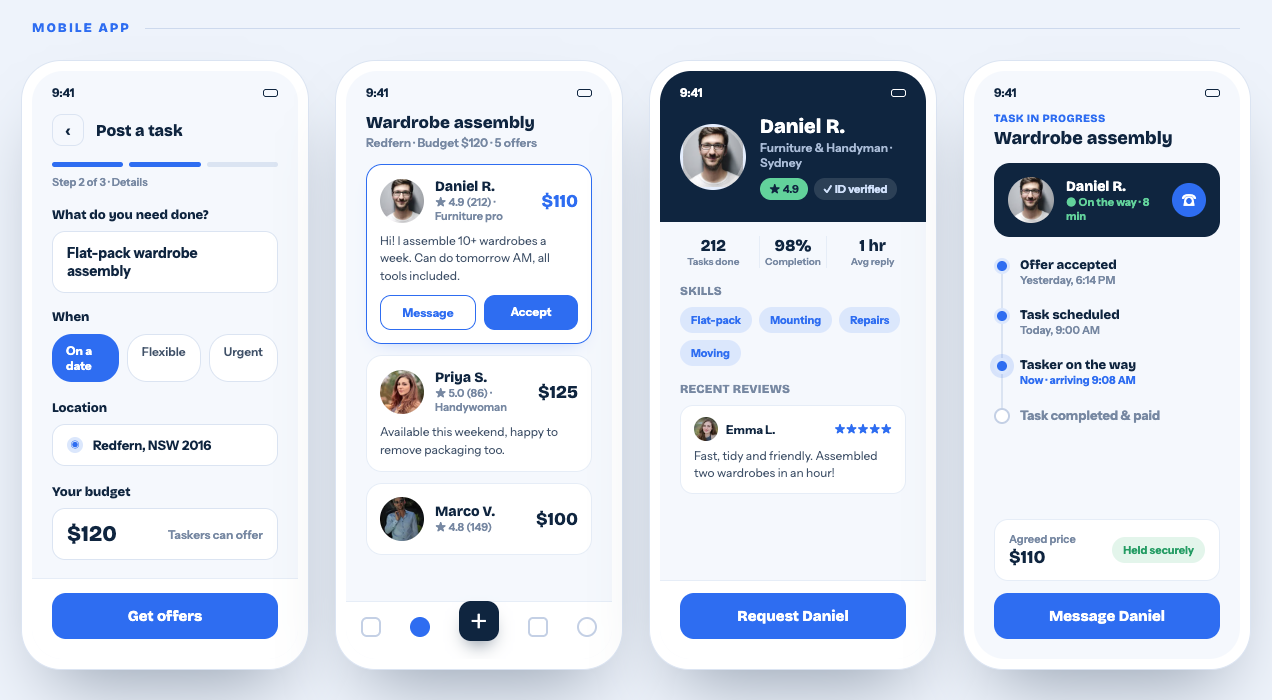
The mechanism that defines the platform is the task auction:
- A customer posts a task with a description, location, date — and a budget. “Assemble a wardrobe, Saturday, $80.”
- Taskers respond with offers: at the budget, under it, or above it with a justification.
- The customer picks a tasker based on price, reviews, completion rate, and profile badges.
- Payment is secured up front and held until the task is marked complete.
- Both sides review each other, feeding the reputation system.
This budget-anchored auction was a deliberate founding decision. When Tim Fung and Jonathan Lui built the platform in 2012 — the idea born from Fung’s own apartment move and the realization that plenty of people would happily do those tasks for money — they chose Airbnb-style price discovery, where users set prices, over Uber-style dictated pricing.
That single choice shapes everything about the model: it makes the platform feel fair to both sides, lets the market find the real local price for any task, and works across an almost unlimited range of categories, because the platform never has to know what a “fair price” for wardrobe assembly in Manchester is. The market figures it out.
The company listed on the ASX in March 2021 and today operates marketplaces in Australia (dominant), the UK and US (fast-growing), plus New Zealand, Ireland, and Singapore.
The revenue streams, one by one
1. Tasker service fees — the engine
The core of the model is a commission deducted from the tasker’s earnings when a task completes. Critically, it’s not a flat rate:
Airtasker uses a tiered sliding scale based on the tasker’s track record, running from roughly 20% for new taskers down to about 10% for top-tier, high-volume performers.
This tiering is the most underrated piece of design in the whole model. The number one complaint on every gig platform in the world is commission size. Airtasker’s answer converts that complaint into a retention mechanic: the better and busier you are as a tasker, the less you pay.
Your best supply — the taskers who fill the most tasks and generate the most reviews — gets the best deal, which gives them a growing reason to stay rather than drift to a competitor. Fee resentment becomes a loyalty ladder.
2. Customer-side booking fees
On top of the tasker commission, Airtasker charges posters a booking fee tied to the task value. Individually small, but at scale it meaningfully lifts the platform’s overall take.
3. The supporting streams
Around the two core fees sit smaller monetization layers: cancellation fees (introduced with a revised cancellation policy that also cut cancellations sharply — a rare fee that improves marketplace quality), insurance built into transactions, and payment margins. Together these push the monetization rate — total revenue as a share of gross marketplace volume — to 21.6% in FY25, up from 20.0% the year before. That number is the single most useful benchmark in this article, and we’ll come back to it.
What the actual financials show
Because Airtasker reports publicly, we can see exactly how the model performs. The FY25 results (year ended June 2025):
- Group revenue: A$52.6 million, up 12.8% year on year, with marketplace revenue up 18.3% to A$45.0 million
- Gross marketplace volume (GMV): A$208.7 million, up 9.5%, from 835,647 booked tasks
- Monetization rate: 21.6% — up from 20.0% in FY24 and 17.6% in FY23
- Gross profit margin: 95.8%
- Free cash flow: positive A$1.2 million — the second consecutive positive year — with A$19.1 million in cash and no debt burden weighing on the model
- The Australian marketplace alone generated roughly A$15 million in cash flow after covering global head office costs
And the growth story is now international: in FY25 UK revenue grew 111% to a GMV run rate of A$21 million, and the US grew from a small base at over 400% revenue growth to a A$7.5 million GMV run rate. The momentum continued into the most recent half-year (announced February 2026), with Australian GMV hitting a record A$103.5 million for the half.
Three lessons hide in those numbers:
The margin is the model. A 95.8% gross margin is what “we own no tools and employ no taskers” looks like in accounting form. The platform’s cost of revenue is essentially payment processing and insurance; everything else is margin available for product and growth. This is why marketplace models attract founders and investors: once liquidity exists, nearly every incremental dollar is profit-grade.
Monetization rate climbs with trust, not greed. Airtasker’s take went from 17.6% to 21.6% in two years — not by raising headline commissions, but by layering booking fees, cancellation fees, and better completion rates. A young marketplace cannot start at 21%; Airtasker couldn’t either. The rate is earned as the platform proves it delivers value both sides can’t get elsewhere.
Profitability took a decade. Founded 2012, consistently free-cash-flow positive from FY24. Marketplaces are compounding machines with long fuses — which is exactly why keeping your build and burn costs low in the early years matters so much.
Why the model works (and where it strains)
The structural strengths. Airtasker is a pure platform: it owns no assets, employs no service providers, and scales revenue with liquidity rather than headcount. Network effects run in both directions — more taskers mean faster offers and better prices, which attract more customers, which attract more taskers. The auction handles price discovery automatically across hundreds of categories. And the reputation system compounds: years of reviews are an asset no new entrant can copy.
The honest weaknesses. Every task marketplace fights the same three battles. Liquidity chicken-and-egg: a customer who posts into silence never returns, which is why Airtasker’s own international playbook targets one city at a time with heavy local brand investment rather than launching thin everywhere. Leakage: once a customer finds a tasker they like, both sides have an incentive to take repeat work off-platform and skip the fees — the tiered commission (cheaper fees for loyal taskers) is partly an anti-leakage weapon. Geographic concentration: Australia still produces the overwhelming majority of revenue, and the company’s own results show how much sustained marketing investment (including eight-figure media partnerships in the UK) it takes to open each new country.
That last weakness is worth reading twice, because it’s also the opportunity: the model is proven, but most of the world’s map is still empty. Airtasker operates seriously in a handful of countries. Everywhere else, the budget-anchored task auction — a model now validated by a public company’s decade of accounts — simply doesn’t exist yet.
How Airtasker compares with TaskRabbit and Thumbtack
The three big names in local services monetize completely differently, and the difference matters if you’re studying the space:
- Airtasker is an auction: customers name a budget, taskers bid, and the platform takes a commission on completion. Revenue scales with completed transactions.
- TaskRabbit is direct booking: customers browse taskers’ hourly rates and hire one. Simpler flow, faster hiring, less price competition — we’ve broken down that model in our TaskRabbit clone guide.
- Thumbtack is lead generation: professionals pay for customer introductions, whether or not they win the job. The platform monetizes intent rather than transactions — a fundamentally different architecture, which we’ve covered in our guide to launching a Thumbtack clone with WordPress.
Each model suits different markets and categories. For a fuller view of the competitive field — including the regional players — see our roundup of sites like Airtasker.
What founders should copy — and what to change
This is the section the business-school analyses never write, so let’s be practical. If you’re building a task marketplace of your own:
Copy the budget-anchored auction. It’s the mechanism that lets one platform serve unlimited categories without pricing knowledge, and it’s psychologically sticky: customers feel in control, taskers compete on their own terms.
Copy the tiered commission — or leapfrog it. The sliding scale is brilliant retention design. But there’s a wedge Airtasker has left open: a flat subscription for taskers with zero commission. It’s the single most requested alternative among gig workers tired of percentage cuts, and for a new marketplace fighting for supply, “keep 100% of what you earn” is the strongest recruiting pitch that exists.
Copy the escrow and two-sided reviews. Non-negotiable. Payment security and reputation are what let strangers transact; they’re the product.
Don’t copy the launch-everywhere instinct — Airtasker doesn’t either. The company’s own stated international strategy is city-level marketplaces, roughly A$25 million GMV per city as the target, built one at a time with concentrated marketing. Your version of that discipline: one city or one vertical, with tasker supply recruited by hand before you spend a dollar on customer acquisition.
Benchmark your take rate honestly. Airtasker’s 21.6% is a mature platform’s number. At launch, expect to monetize far less — a lower commission, or free posting, is the price of building liquidity. The model’s history shows the rate can climb steadily once the platform proves its value.
Respect the timeline — by shortening the expensive part. A decade to consistent free cash flow is the reality of marketplace compounding. You can’t skip the liquidity-building years, but you can skip spending them paying off a $150,000 from-scratch platform build.
We’ve laid out the full economics in our guide to how much a marketplace app costs to build — the short version is that a proven stack gets the entire Airtasker flow live for a small fraction of that, leaving your capital for the fight that actually decides marketplace outcomes: supply, liquidity, and local brand.
For the complete step-by-step playbook — positioning, features, tech stack, and launch strategy — read our guide on how to build an Airtasker app. And if you’d rather see what the platform itself looks like ready-made, our Airtasker clone page covers the builds, from a WordPress MVP to a Laravel platform with native iOS and Android apps.
Frequently asked questions
How does Airtasker make money?
Primarily through a service fee deducted from taskers’ earnings on completed tasks, on a sliding scale from roughly 20% down to about 10% for top-rated taskers, plus booking fees charged to customers and smaller streams like cancellation fees and insurance. In FY25 this produced A$52.6 million in group revenue.
What percentage does Airtasker take?
The overall monetization rate — total revenue as a share of everything transacted on the platform — was 21.6% in FY25. Individual taskers pay a commission between roughly 10% and 20% depending on their tier, and customers pay a booking fee on top.
Is Airtasker profitable?
Airtasker has delivered positive free cash flow for two consecutive financial years (FY24 and FY25), with its Australian marketplace generating substantial cash that funds expansion into the UK and US. Gross margins run above 95%.
Who owns Airtasker?
Airtasker is a public company listed on the Australian Securities Exchange under the ticker ART. It was co-founded in 2012 by Tim Fung, who remains CEO, and Jonathan Lui.
Can I build a business with the same model?
Yes — the model is proven and publicly documented, but the brand, design, and trademarks are Airtasker’s. What founders build is the model: a budget-anchored task auction under their own brand, usually for a geography or vertical the incumbents don’t serve. That’s exactly what our Airtasker-style marketplace builds deliver, with full source code.